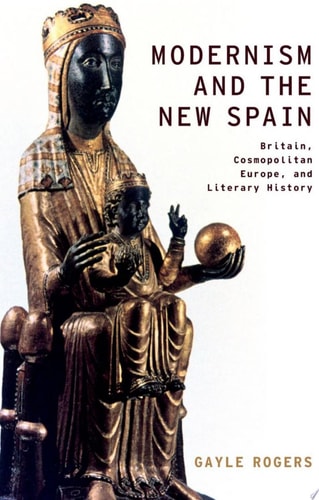
Modernism and the New Spain: Britain, Cosmopolitan Europe, and Literary History
0
0
As an Amazon Associate and affiliate partner, Menrva Books earns from qualifying purchases. Learn more
Author Description
How and why did a country seen as remote, backwards, and barely European become a pivotal site for reinventing the continent after the Great War? Modernism and the New Spain argues that the "Spanish problem"-the nation's historically troubled relationship with Europe-provided an animating impulse for interwar literary modernism and for new conceptions of cosmopolitanism. Drawing on works in a variety of genres, Gayle Rogers reconstructs an archive of cross-cultural exchanges to reveal the mutual constitution of two modernist movements-one in Britain, the other in Spain, and stretching at key moments in between to Ireland and the Americas.Several sites of transnational collaboration form the core of Rogers's innovative literary history.The relationship between T. S. Eliot's Criterion and José Ortega y Gasset's Revista de Occidente shows how the two journals joined to promote a cosmopolitan agenda. A similar case of kindred spirits appears with the 1922 publication of Joyce's Ulysses. The novel's forward-thinking sentiments on race and nation resonated powerfully within Spain, where a generation of writers searched for non-statist forms through which they might express a new European Hispanicity. These cultural ties between the Anglo-Irish and Spanish-speaking worlds increased with the outbreak of civil war in 1936. Rogers explores the connections between fighting Spanish fascism and dismantling the English patriarchal system in Virginia Woolf's Three Guineas, along with the international, anti-fascist poetic community formed by Stephen Spender, Manuel Altolaguirre, and others as they sought to establish Federico García Lorca as an apolitical Spanish-European poet.Mining a rich array of sources that includes novels, periodicals, biographies, translations, and poetry in English and in Spanish, Modernism and the New Spain adds a vital new international perspective to modernist studies, revealing how writers created alliances that unified local and international reforms
Menrva's Summary
THE THESIS
This work investigates how Spain, often perceived as peripheral to European intellectual life, served as a central catalyst for the development of interwar modernist movements in Britain and beyond. Gayle Rogers, an associate professor of English, utilizes a comparative framework to analyze the intellectual exchanges between Anglo-Irish and Spanish writers. By examining the intersection of literary production and political crisis, the author argues that the 'Spanish problem' was instrumental in shaping new definitions of cosmopolitanism and modern identity.
THE SCOPE MAP
What You Will Find
- Comparative analysis of T. S. Eliot's 'Criterion' and José Ortega y Gasset's 'Revista de Occidente'.
- Examination of the reception of James Joyce's 'Ulysses' within Spanish literary circles.
- Investigation of the anti-fascist literary networks involving Virginia Woolf, Stephen Spender, and Manuel Altolaguirre.
- Analysis of the construction of Federico García Lorca as a symbol of European modernism.
Scope Limits
- The study focuses primarily on the Anglo-Irish and Spanish-speaking literary spheres rather than a comprehensive survey of all European modernist movements.
- The analysis is limited to the interwar period and the immediate cultural impacts of the Spanish Civil War.
THE AUTHORITY PERSPECTIVE
Scholars in the field of modernist studies recognize this text for its rigorous archival research and its ability to bridge the gap between English and Spanish literary traditions. Readers frequently note the academic density of the prose, which serves as a foundational resource for those interested in transnational modernism and the political dimensions of interwar literature.
Page Count:
304
Publication Date:
2014-12-01
Publisher:
Oxford University Press
ISBN-10:
0190207337
ISBN-13:
9780190207335
Comparative
Literary Criticism
In literature
Modernism
Criticism history
European History
Community Tags
Similar Books