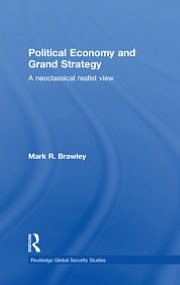
Political Economy and Grand Strategy: A Neoclassical Realist View
0
0
As an Amazon Associate and affiliate partner, Menrva Books earns from qualifying purchases. Learn more
Author Description
This book examines traditional balance of power theory from a political-economic perspective, using historical examples, to draw out distinctions between the liberal and realist approach and how this affects grand strategy.The realist view of the balance of power theory includes implicit assumptions that economic assets can be turned quickly into power, and that states always respond to threats quickly and only with a view to the 'short-run'. These assumptions drive many of the expectations generated from traditional balance-of-power theory, discouraging realists from looking at domestic sources of power, which in turn undermined their ability to frame strategic decisions properly. By thinking about how power must be managed over time, however, we can model the choices policy-makers confront when determining expenditures on defense, while keeping an eye on the impact of those costs on the economy.By emphasizing the role of the state, identifying different causal patterns in domestic politics, and demonstrating the importance of systemic competition, this book aims to establish why a neo-classical realist approach is not only different from a liberal approach, but also superior when addressing questions on grand strategy.This book will be of much interest to students of security studies, international political economy, grand strategy and IR theory in general.Mark R. Brawley is Professor of Political Science at McGill University, Montreal, Canada. He is author of several books on International Relations, specialising in the connections between political economic issues and security.
Menrva's Summary
THE THESIS
This book investigates how the integration of political-economic factors into neoclassical realist theory provides a more accurate framework for understanding state grand strategy than traditional balance of power models. Professor Mark R. Brawley, a specialist in international relations at McGill University, utilizes historical case studies to challenge the realist assumption that economic assets translate instantaneously into military power. By analyzing the domestic constraints on state decision-making and the long-term management of defense expenditures, the author argues that neoclassical realism offers a superior analytical tool for evaluating how states respond to systemic competition.
THE SCOPE MAP
What You Will Find
- Comparative analysis between liberal and realist approaches to international security.
- A neoclassical realist framework for modeling policy-maker choices regarding defense spending.
- Historical case studies demonstrating the impact of domestic political structures on strategic outcomes.
- Theoretical arguments regarding the temporal management of power and economic costs.
THE AUTHORITY PERSPECTIVE
Scholars and students of international relations identify this work as a significant contribution to the intersection of security studies and political economy. Readers frequently note the academic density of the prose, which serves as a foundational text for those examining the domestic sources of grand strategy.
Page Count:
158
Publication Date:
2010-01-01
Publisher:
Routledge
ISBN-10:
0203869869
ISBN-13:
9780203869864
History
Economics
Politics
Specific Topics
International relations
Security Studies
Community Tags
Similar Books