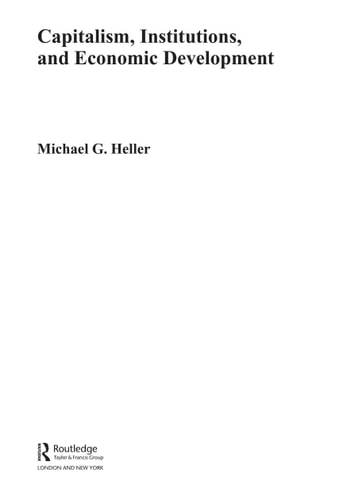
Capitalism, Institutions and Economic Development
0
0
As an Amazon Associate and affiliate partner, Menrva Books earns from qualifying purchases. Learn more
Author Description
Based On A Timely Reassessment Of The Classic Arguments Of Weber, Schumpeter, Hayek, Popper, And Parsons, This Book Reconceptualizes Actually-existing Capitalism. It Proposes Capitalism As An Impersonal Procedural Solution To The Problems Of Spontaneously Coordinating Public Institutions That Enable Durable Market-based Wealth Generation And Social Order. Few Countries Have Achieved This. A Novel Contribution Of The Book Is That It Identifies A Practical Sequence Of Economic And Institutional Shortcuts To Real Capitalism. The Book Challenges Current Orthodoxies About Varieties Of Capitalism And Relativist Recipes For Economic Growth, And It Criticizes Culturalist And Incrementalist Viewpoints In Institutional Economics. It Calls On The Social Sciences To Help In Constructing Dynamic And Prosperous Open Societies Of The Twenty-first Century By Reclaiming Older Ideas Of 'social Economics'. Better And Faster Solutions Will Emphasize Crisis-induced Change, Rational Leadership, Ideological Persuasion, Institutional Engineering, Rules-based Market Freedom, And The Universalistic Formal-procedural Impersonality Of Optimal Regulatory Systems.
Menrva's Summary
THE THESIS
This book investigates the structural requirements for establishing durable, market-based wealth generation and social order within modern economies. Michael J. Heller synthesizes classical economic theories from thinkers like Weber, Schumpeter, and Hayek to propose that capitalism functions as an impersonal procedural solution to the coordination of public institutions. He argues against incrementalist and culturalist perspectives, instead advocating for a deliberate, crisis-induced sequence of institutional engineering to achieve economic prosperity.
THE SCOPE MAP
What You Will Find
- A theoretical framework defining capitalism as an impersonal procedural system for public coordination.
- A proposed practical sequence for economic and institutional transition in developing societies.
- Critical analysis of existing orthodoxies regarding varieties of capitalism and growth strategies.
- Examination of the roles of rational leadership, ideological persuasion, and rules-based market freedom in regulatory systems.
THE AUTHORITY PERSPECTIVE
Experts recognize this work as a rigorous challenge to contemporary institutional economics, particularly for its focus on formal-procedural impersonality. Readers frequently note the academic density of the prose, which requires a strong background in social science theory to fully grasp the author's proposed transition sequences.
Page Count:
320
Publication Date:
2009-01-01
Publisher:
Routledge
ISBN-10:
0203873408
ISBN-13:
9780203873403
Economics
Business
Sociology
Economics
Community Tags
Similar Books