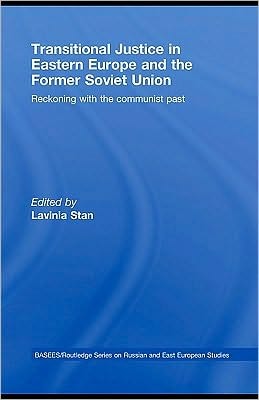
Transitional Justice in Eastern Europe and the Former Soviet Union
0
0
As an Amazon Associate and affiliate partner, Menrva Books earns from qualifying purchases. Learn more
Author Description
During the last two decades, the countries of Eastern Europe and the former Soviet Union have attempted to address the numerous human rights abuses that characterized the decades of communist rule. This book examines the main processes of transitional justice that permitted societies in those countries to come to terms with their recent past. It explores lustration, the banning of communist officials and secret political police officers and informers from post-communist politic, ordinary citizens’ access to the remaining archives compiled on them by the communist secret police, as well as trials and court proceedings launched against former communist officials and secret agents for their human rights trespasses. Individual chapters explore the progress of transitional justice in Germany, the Czech Republic, Slovakia, Poland, Hungary, Romania, Bulgaria, Albania, Slovenia and the successor states of the former Soviet Union. The chapters explain why different countries have employed different models to come to terms with their communist past; assess each country’s relative successes and failures; and probe the efficacy of country-specific legislation to attain the transitional justice goals for which it was developed. The book draws together the country cases into a comprehensive comparative analysis of the determinants of post-communist transitional justice, that will be relevant not only to scholars of post-communist transition, but also to anyone interested in transitional justice in other contexts.
Menrva's Summary
THE THESIS
This volume investigates the mechanisms and efficacy of transitional justice processes implemented by post-communist states to address human rights abuses committed during the era of communist rule. Edited by Lavinia Stan, a scholar specializing in post-communist politics, the book synthesizes comparative data from across Eastern Europe and the former Soviet Union. It evaluates the legislative and judicial frameworks used to confront the past, focusing on why specific nations adopted divergent models for accountability and reconciliation.
THE SCOPE MAP
What You Will Find
- Comparative analysis of lustration policies and the banning of former communist officials from public office.
- Examination of citizen access to secret police archives and the legal processes surrounding these records.
- Case studies covering Germany, the Czech Republic, Slovakia, Poland, Hungary, Romania, Bulgaria, Albania, Slovenia, and former Soviet states.
- Assessment of the success and failure rates of specific transitional justice legislation in achieving national goals.
THE AUTHORITY PERSPECTIVE
Experts identify this work as a foundational comparative study for understanding the legal and political complexities of post-communist transitions. Readers frequently note the academic density of the prose and its utility for scholars analyzing human rights and institutional reform.
Page Count:
307
Publication Date:
2008-01-01
Publisher:
Taylor & Francis, Inc.
ISBN-10:
0203887786
ISBN-13:
9780203887783
History
Human rights
Soviet Union
Law
Eastern Europe
Community Tags
Similar Books