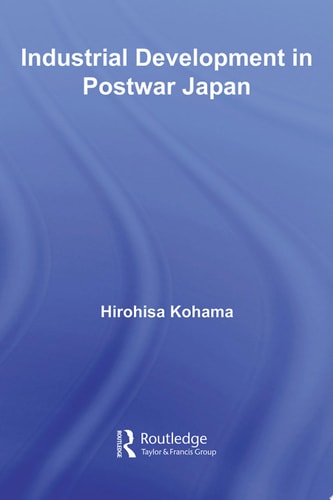
Industrial Development in Postwar Japan
0
0
As an Amazon Associate and affiliate partner, Menrva Books earns from qualifying purchases. Learn more
Author Description
Structured into sub-sector by sub-sector analyses, this book provides a clear and accessible examination of industrial development, without over-generalizing or being weighed down by historical details. Written by an authority in the area of development economics it explores the companies and the individuals that have pushed Japan's economy forwards.Kohama situates the ‘miraculous growth’ of the Japanese economy in the 1960s in the trade liberalization policy of 1960 and the income doubling plan that commenced in 1961, yet also analyzes the pre-war structures that were in place to facilitate such a 'miracle.' Combining policy analysis with empirical industry-specific analysis, he argues that private dynamism was the real driver of change, rather than policy alone.Reviewing the macroeconomic development of the economy but focusing on the development of the industrial sub-sectors that dominated Japan’s industrial scene at various stages of development and structural changes that happened in the process of industrial development, this book is ideal reading for graduate students taking courses on economic development.
Menrva's Summary
THE THESIS
This book investigates the primary drivers of Japan's rapid industrial expansion during the postwar era, specifically questioning the extent to which government policy versus private sector dynamism facilitated this growth. Hirohisa Kohama, an established authority in development economics, utilizes a combination of macroeconomic data and granular, industry-specific analysis to evaluate the structural changes within the Japanese economy. He argues that while state-led initiatives like the 1961 income doubling plan provided a framework, the true engine of progress was the innovation and adaptability of private enterprises and individual actors.
THE SCOPE MAP
What You Will Find
- Analysis of the 1960 trade liberalization policy and its long-term economic impact.
- Comparative study of pre-war industrial structures and their influence on postwar recovery.
- Sub-sector specific examinations of key industries that defined Japan's industrial landscape.
- Empirical data evaluating the efficacy of government planning versus market-driven industrial growth.
THE AUTHORITY PERSPECTIVE
Experts and academics frequently cite this work as a foundational text for graduate-level courses on economic development due to its balanced approach. Readers often note the clarity of the prose, which manages to avoid excessive historical density while maintaining rigorous economic analysis.
Page Count:
226
Publication Date:
2007-01-01
Publisher:
Taylor & Francis Group
ISBN-10:
0203939425
ISBN-13:
9780203939420
Economics
History
Japan
Manufactures