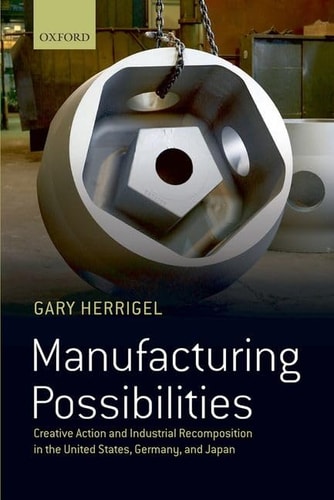
Manufacturing Possibilities: Creative Action and Industrial Recomposition in the United States, Germany, and Japan
0
0
As an Amazon Associate and affiliate partner, Menrva Books earns from qualifying purchases. Learn more
Author Description
Manufacturing Possibilities examines adjustment dynamics in the steel, automobile and machinery industries in Germany, the U.S., and Japan since World War II. As national industrial actors in each sector try to compete in global markets, the book argues that they recompose firm and industry boundaries, stakeholder identities and interests, and governance mechanisms at all levels of their political economies. Micro level study of industrial transformation in this way provides a significant window on macro level processes of political economic change in the three societies.Theoretically, the book marks a departure from both neoliberal economic and historical institutionalist perspectives on change in advanced political economies. It characterizes industrial change as a creative, bottom-up process driven by reflective social actors. This alternative view consists of two distinctive claims. The first is that action is social, reflective, and ultimately creative. When their interactive habits are disrupted, industrial actors seek to repair their relations by reconceiving them. Such imaginative interaction redefines interest and causes unforeseen possibilities for action to emerge, enabling actors to trump existing rules and constraints. Second, industrial change driven by creative action is recompositional. In the social process of reflection, actors rearrange, modify, reconceive, and reposition inherited organizational forms and governance mechanisms as they experiment with solutions to the challenges that they face. Continuity in relations is interwoven with continuous reform and change. Most remarkably, creativity in the recomposition process makes the introduction of entirely new practices and relations possible.Ultimately, the message of Manufacturing Possibilities is that social study of change in advanced political economies should devote itself to the discovery of possibility. Preoccupation with constraint and failure to appreciate the capaciousness of reflective
Menrva's Summary
THE THESIS
This book investigates how industrial actors in the United States, Germany, and Japan creatively recompose their organizational structures and governance mechanisms to navigate global market competition. Gary Herrigel, a professor of political science, utilizes a comparative historical approach to analyze the steel, automobile, and machinery sectors since World War II. He argues against traditional neoliberal and institutionalist models, proposing instead that industrial change is a bottom-up, reflective process where actors actively reimagine their relationships and constraints to generate new possibilities for action.
THE SCOPE MAP
What You Will Find
- Comparative analysis of steel, automobile, and machinery industries across three major global economies.
- A theoretical framework centered on creative action and industrial recomposition.
- Case studies illustrating how social actors redefine interests and governance in response to market disruption.
- An examination of the interplay between inherited organizational forms and continuous reform.
THE AUTHORITY PERSPECTIVE
Scholars in the field of political economy recognize this work as a significant challenge to conventional institutionalist theories of industrial change. Readers frequently note the academic density of the prose, which provides a rigorous, sociologically informed perspective on how firms adapt to global economic pressures.
Page Count:
296
Publication Date:
2013-02-07
Publisher:
Oxford University Press
ISBN-10:
0199665982
ISBN-13:
9780199665983
Economics
Industrial history
Manufactures
Japan
Manufacturing
United States
Sociology
Community Tags
Similar Books






Reader Comments
Share Your Thoughts
No comments yet. Be the first to share your thoughts!