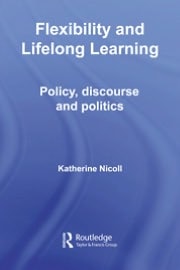
Flexibility and Lifelong Learning
0
0
As an Amazon Associate and affiliate partner, Menrva Books earns from qualifying purchases. Learn more
Author Description
What can the politics of discourse tell us about the discourse of politics?How are flexibility and lifelong learning positioned within policy?Flexibility and lifelong learning have become key aspects of education policy in nation states and bodies such as the European Union and Organisation of Economic Cooperation and Development in recent years. They are positioned as necessary for the knowledge economy and social inclusion. The failure to adapt through becoming more flexible and participating in lifelong learning is held up as a failure at individual, organisational and national levels.But how has that narrative come to be constructed? In what ways is it persuasive? And what forms of political action are possible and necessary? These are the questions addressed in this text. Drawing upon the work of Michel Foucault and on the notion of rhetoric, this book forensically explores examples of the work of policy texts in the discourses of education, lifelong learning and flexibility that they construct. In so doing, it argues for the need to take policy discourse seriously and not simply dismiss it as ‘spin’.Through a detailed examination of policy texts from primarily Australia, the UK and European Union, this text provides insights into the strategies through which flexibility and lifelong learning become realized and realizable as part of the common sense of educational discourse. Rather than simply rejecting these ideas, or suggesting they are merely the window dressing for the more malign interests of the knowledge economy or globalization, it suggests a politics of the wedge and possibilities for the insertion of different meanings. Central to the claims of this text are that we need to engage closely with the discursive and rhetorical strategies of policy, in order that we understand both how it is constructed and thus how it can be deconstructed.
Menrva's Summary
THE THESIS
This book investigates how the concepts of flexibility and lifelong learning are constructed through policy discourse and how these narratives shape modern educational systems. Katherine Nicoll, an expert in educational policy and discourse analysis, utilizes the theoretical framework of Michel Foucault and rhetorical analysis to examine how these terms have become normalized within global policy. She argues that these concepts are not merely political rhetoric but are active tools that define individual and national success in the knowledge economy.
THE SCOPE MAP
What You Will Find
- Analysis of policy documents from Australia, the UK, and the European Union.
- Application of Foucaultian discourse analysis to educational policy.
- Examination of the rhetorical strategies used to frame lifelong learning as a necessity.
- A proposed methodology for deconstructing policy narratives to identify alternative meanings.
THE AUTHORITY PERSPECTIVE
Scholars in the field of educational policy view this text as a rigorous application of critical discourse analysis to contemporary economic mandates. Readers frequently note the academic density of the prose, which requires a foundational understanding of Foucaultian theory to fully grasp the author's arguments.
Page Count:
176
Publication Date:
2006-01-01
Publisher:
London ; Routledge, 2006.
ISBN-10:
0203969448
ISBN-13:
9780203969441
Philosophy
Policy Studies
Sociology
Education
Community Tags
Other Editions(3)

Similar Books


Reader Comments
Share Your Thoughts
No comments yet. Be the first to share your thoughts!