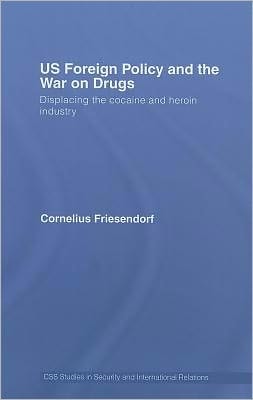
US Foreign Policy and the War on Drugs: Displacing the Cocaine and Heroin Industry
0
0
As an Amazon Associate and affiliate partner, Menrva Books earns from qualifying purchases. Learn more
Author Description
This Book Explores How Us Foreign Policy Has Exacerbated The Global Drug Problem. It Analyses A Crucial Side Effect Of Coercive Us Strategies On Farmers, Traffickers And Governments: The Geographic Displacement Of The Cocaine And Heroin Industry. This Volume Thus Offers An Original Explanation Of The Adaptability Of Drug Markets To State Pressure. Using Ir Theory, The Book Highlights The Negative Consequences Of Policies That Rely On Coercion.
Menrva's Summary
THE THESIS
This book investigates how coercive United States foreign policy strategies have inadvertently exacerbated the global drug trade by forcing the cocaine and heroin industries to relocate rather than disappear. Cornelius Friesendorf, a scholar in international relations, utilizes a framework grounded in IR theory to analyze the unintended consequences of state-led pressure on drug markets. By examining historical case studies, the author argues that the adaptability of illicit industries often renders traditional prohibitionist policies ineffective or counterproductive.
THE SCOPE MAP
What You Will Find
- Analysis of the geographic displacement of cocaine and heroin production networks.
- Application of International Relations theory to illicit market dynamics.
- Historical case studies including the 1970s French Connection and Andean smuggling operations.
- Evaluation of alternative policy frameworks beyond the traditional war on drugs.
THE AUTHORITY PERSPECTIVE
Experts recognize this work as a rigorous academic examination of the systemic failures inherent in coercive drug control policies. Readers frequently note the dense, analytical nature of the prose, which provides a foundational perspective for students of international security and public policy.
Page Count:
240
Publication Date:
2007-01-01
Publisher:
Taylor & Francis Group
ISBN-10:
0203964594
ISBN-13:
9780203964590
History
Criminology
Public Policy
International relations
Cocaine
Drug control