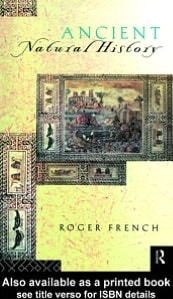
Ancient Natural History: Histories of Nature
0
0
As an Amazon Associate and affiliate partner, Menrva Books earns from qualifying purchases. Learn more
Author Description
Ancient Natural History surveys the ways in which people in the ancient world thought about nature. The writings of Aristotle, Theophrastus, Strabo, Pliny are examined, as well as the popular beliefs of their contemporaries. Roger French finds that the same natural-historical material was used to serve the purposes of both the Greek philosopher and the Christian allegorist, or of a taxonomist like Theophrastus and a collector of curiosa like Pliny. He argues convincingly that the motives of ancient writers on nature were rarely 'scientific' and, indeed, that there was not really any science at all in the ancient world. This book will make fascinating reading for students, academics and anyone who is interested in the history of science, or in the ancient history of ideas.
Menrva's Summary
THE THESIS
This book investigates the fundamental question of whether ancient natural history can be classified as science or if it served entirely different intellectual and cultural purposes. Roger French, a scholar in the history of science, examines the works of seminal figures such as Aristotle, Theophrastus, Strabo, and Pliny to challenge modern assumptions about ancient inquiry. By analyzing how these authors utilized natural-historical data, French argues that their primary motivations were rarely scientific in the modern sense, suggesting that the concept of science as a distinct discipline did not exist in the ancient world.
THE SCOPE MAP
What You Will Find
- Analysis of primary texts from Aristotle, Theophrastus, Strabo, and Pliny.
- Examination of the intersection between philosophical inquiry and popular ancient beliefs.
- Comparison of how natural history was adapted for diverse uses, including Christian allegory and the collection of curiosa.
- A critical framework for understanding the motives behind ancient intellectual production.
THE AUTHORITY PERSPECTIVE
Scholars and students of the history of ideas frequently cite this work for its provocative stance on the nature of ancient inquiry. The text is recognized as a significant contribution to the historiography of science, challenging readers to reconsider the development of scientific thought.
Page Count:
384
Publication Date:
2005-01-01
Publisher:
Taylor & Francis Group
ISBN-10:
0203974166
ISBN-13:
9780203974162
History
Science
Non-Fiction
Philosophy
Natural History
Ancient History
Community Tags
Similar Books