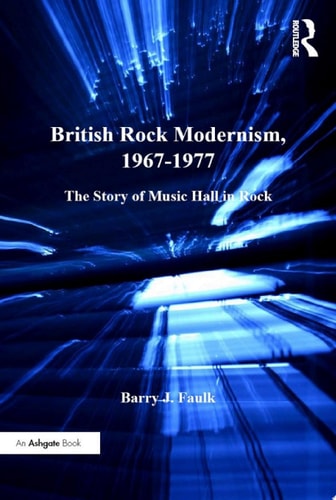
British Rock Modernism, 1967-1977
0
0
As an Amazon Associate and affiliate partner, Menrva Books earns from qualifying purchases. Learn more
Author Description
British Rock Modernism, 1967-1977 explains how the definitive British rock performers of this epoch aimed, not at the youthful rebellion for which they are legendary, but at a highly self-conscious project of commenting on the business in which they were engaged. They did so by ironically appropriating the traditional forms of Victorian music hall. Faulk discuses on the mid to late 1960s, when British rock bands who had already achieved commercial prominence began to aspire to aesthetic distinction. The book discusses recordings such as the Beatles' Magical Mystery Tour album, the Kinks' The Village Green Preservation Society, and the Sex Pistols' Never Mind the Bollocks, Here's the Sex Pistols, and television films such as the Beatles' Magical Mystery Tour and the Rolling Stones' Rock and Roll Circus that defined rock's early high art moment. Faulk argues that these t̀exts' disclose the primary strategies by which British rock groups, mostly comprised of young working and lower middle-class men, made their bid for aesthetic merit by sampling music hall sounds. The result was a symbolically charged form whose main purpose was to unsettle the hierarchy that set traditional popular culture above the new medium. Rock groups engaged with the music of the past in order both to demonstrate the comparative vitality of the new form and signify rock's new art status, compared to earlier British pop music. The book historicizes punk rock as a later development of earlier British rock, rather than a rupture. Unlike earlier groups, the Sex Pistols did not appropriate music hall form in an ironic way, but the band and their manager Malcolm McLaren were obsessed with the meaning of the past for the present in a distinctly modernist fashion. British Rock Modernism also sets the notion of authenticity in a broader context as well, encompassing in this case the revival of the traditional male artist-hero celebrated by British modernist literature. Situating rock in the more extensive history of modern British musical product on offers insight into the gendered division of labour that still names the reception of British popular music. As demonstrated in the opening chapter, discusing on key women singers of the 1960s, the music hall legacy is partly responsible for both privileging male rock groups with the mantle of artist, and with burdening women with stereotypes that relegated women performers to the status of mere èntertainers'. --Book Jacket.
Menrva's Summary
THE THESIS
This book investigates how British rock musicians between 1967 and 1977 pursued aesthetic distinction by ironically appropriating the forms of Victorian music hall. Barry J. Faulk, a scholar of cultural studies, analyzes key recordings and films from this era, including works by The Beatles, The Kinks, and The Sex Pistols. Faulk argues that these artists used music hall sounds to challenge the hierarchy that placed traditional popular culture above new media, thereby asserting rock's new art status. The book also frames punk rock as a continuation rather than a rupture, and situates the concept of authenticity within the revival of the traditional male artist-hero found in British modernist literature.
THE SCOPE MAP
- Analysis of the period 1967-1977 in British rock music.
- Exploration of the appropriation of Victorian music hall forms by rock musicians.
- Discussion of specific works: The Beatles' 'Magical Mystery Tour', The Kinks' 'The Village Green Preservation Society', The Sex Pistols' 'Never Mind the Bollocks, Here's the Sex Pistols', and The Rolling Stones' 'Rock and Roll Circus'.
- Argument for rock music's bid for aesthetic distinction and art status.
- Historicization of punk rock as a development of earlier British rock.
- Examination of the notion of authenticity in relation to the revival of the male artist-hero in modernist literature.
THE AUTHORITY PERSPECTIVE
The book positions British rock performers of the 1967-1977 era not as rebels, but as participants in a self-conscious project to comment on their industry through the ironic use of Victorian music hall traditions. It highlights how bands sought aesthetic distinction by sampling these older sounds, aiming to unsettle cultural hierarchies. The work also frames punk rock as a later evolution rather than a break from earlier trends, and connects the pursuit of authenticity to the modernist literary tradition of the male artist-hero. The analysis covers seminal works and argues for rock's elevation to art status.
Page Count:
192
Publication Date:
2016-05-23
Publisher:
Taylor & Francis
ISBN-10:
1317171519
ISBN-13:
9781317171515
History
Non-Fiction
Music
Music History
Rock music
Modernism
Community Tags
Similar Books
Reader Comments
Share Your Thoughts
No comments yet. Be the first to share your thoughts!