
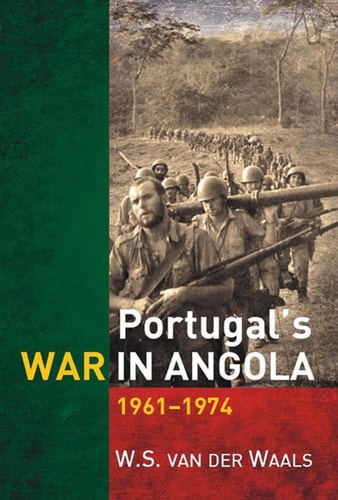
Portugal's War in Angola, 1961-1974
0
0
As an Amazon Associate and affiliate partner, Menrva Books earns from qualifying purchases. Learn more
Author Description
On 4 February 1961, the day regarded by the MPLA as the start of its national revolution, the storm broke. Taken unawares by the shock of the uprisings in Angola, and the subsequent bloody Bacongo insurrection on 15 March 1961, Portugal was to plunge its armed forces, untested since World War I, into an urgent counteroffensive. In January 1961, Angola, one of Portugal's most thriving 'overseas provinces' was in the eye of a storm. A period of sustained growth in the 1950s, a golden decade of Portuguese African history, had led to Angola becoming one of Portugal's most prized possessions. National development plans were embarked on with zeal; new roads, railways, factories, harbors, airfields and settlements were built and exports increased dramatically. While the rest of Africa was in turmoil, Angola and Portuguese Mozambique seemed like oases of peace and progress. Couched between its high-sounding principles and its policy of Luso-Tropicalism, Portugal marched ever onwards to the beat of its own drum, seemingly oblivious to its impending fate. Portuguese Prime Minister, Dr. Salazar, had ruled over Portugal's colonies with an iron fist for over thirty years, enforcing a draconian racial policy on the African territories, whereby the population of the New State was categorized into 'native', white and 'assimilated' groups, and the colonies as a whole, with their burgeoning economies, were bound to the dictates of the European state. The Angolan war has been described as the bloodiest colonial insurgency in the history of Africa south of the Sahara. But it was to become a conflict that Portugal would lose not on the battlefield, but in the hearts of its own citizens. After a thirteen-year war of attrition in Angola, and facing increasing setbacks in two of its other war-torn territories, an enervated Portugal with its weary armed forces would deal the final blow to itself.
Menrva's Summary
THE THESIS
This book investigates the complex and brutal conflict of Portugal's War in Angola from 1961 to 1974, exploring how a thirteen-year war of attrition, coupled with setbacks in other territories, ultimately led to Portugal's downfall not on the battlefield, but within its own populace. It examines the context of Angola as a thriving 'overseas province' prior to the uprisings, the impact of Prime Minister Salazar's authoritarian rule and racial policies, and the war's designation as one of Africa's bloodiest colonial insurgencies. The narrative framework appears to be a historical account, drawing on the provided description which details key events, political figures, and the socio-economic conditions of the time.
THE SCOPE MAP
- The outbreak of uprisings in Angola on February 4, 1961, and the subsequent Bacongo insurrection.
- Portugal's urgent counteroffensive utilizing armed forces untested since World War I.
- The economic prosperity of Angola in the 1950s and its status as a prized possession.
- Prime Minister Salazar's long-standing rule and his draconian racial policies categorizing the population.
- The war's description as the bloodiest colonial insurgency in African history south of the Sahara.
- The eventual loss of the war not on the battlefield, but in the hearts of Portuguese citizens.
- The impact of thirteen years of attrition in Angola and setbacks in other territories on Portugal's military and populace.
THE AUTHORITY PERSPECTIVE
The description frames Portugal's War in Angola as a pivotal and devastating conflict, highlighting its significant human cost and its ultimate role in Portugal's internal political landscape. The text suggests the war was a bloody insurgency, marking it as one of the most severe colonial conflicts in sub-Saharan Africa. It posits that the war's true impact was psychological and political, eroding the will of the Portuguese people and contributing to the nation's eventual collapse rather than a military defeat. The framing implies a detailed historical analysis of the conflict's causes, progression, and far-reaching consequences for both Angola and Portugal.
Page Count:
300
Publication Date:
2011-01-01
Publisher:
Protea Book House
ISBN-10:
1869193512
ISBN-13:
9781869193515
History
Non-Fiction
Colonialism
African history
Military History
Community Tags
Other Editions(2)
Similar Books
Reader Comments
Share Your Thoughts
No comments yet. Be the first to share your thoughts!