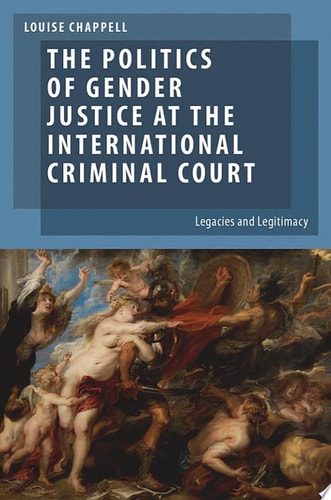
The Politics of Gender Justice at the International Criminal Court: Legacies and Legitimacy
0
0
As an Amazon Associate and affiliate partner, Menrva Books earns from qualifying purchases. Learn more
Author Description
In 1998, the Rome Statute to the International Criminal Court (ICC) emerged as a groundbreaking treaty both due to its codification of international criminal law and its recognition of the crimes committed against women in times of war and conflict. The ICC criminalized acts of rape, sexual slavery, and enforced pregnancy, amongst others, to provide the most advanced articulation ever of gender based violence under international law. However, thus far no scholarly book has analyzed whether or not the implementation of the ICC has been successful. The Politics of Gender Justice at the International Criminal Court fills this intellectual gap, specifically examining the gender justice design features of the Rome Statute (the foundation of the ICC), and assessing the effectiveness of the statute's implementation in the first decade of the court's operation. Louise Chappell argues that although the ICC has provided mixed outcomes for gender justice, there have also been a number of important breakthroughs, particularly in regards to support for female judges. Meticulous and comprehensive, this book refines the notion of gender justice principles and adds a valuable, but as yet unrecognized, gender dimension to the burgeoning historical institutionalist approach to international relations. Chappell links feminist international relations literature with feminist institutionalism literature for the first time, thereby strengthening and adding to both fields. Ultimately, Chappell's analysis is an essential step towards attaining a greater degree of gender equality in the context of international law. The definitive volume on gender and the ICC, The Politics of Gender Justice at the International Criminal Court is a valuable resource for students and scholars of international relations, international law, and human rights.
Menrva's Summary
THE THESIS
This book investigates the efficacy of the International Criminal Court (ICC) in addressing gender-based violence and promoting gender justice during its first decade of operation. Louise A. Chappell, a scholar specializing in gender and international relations, utilizes a historical institutionalist framework to evaluate the implementation of the Rome Statute. She argues that while the ICC has produced mixed outcomes, it has achieved significant progress in institutional representation, specifically regarding the inclusion of female judges. By synthesizing feminist international relations theory with feminist institutionalism, the author provides a comprehensive assessment of the court's structural impact on international law.
THE SCOPE MAP
What You Will Find
- Analysis of the gender justice design features within the Rome Statute.
- Evaluation of the ICC's performance regarding the prosecution of rape, sexual slavery, and enforced pregnancy.
- Integration of feminist institutionalist theory with international relations literature.
- Assessment of institutional changes, including the role and support of female judges.
Scope Limits
- The analysis is primarily restricted to the first decade of the court's operation.
- The text does not provide an exhaustive legal defense manual but focuses on institutional and political outcomes.
THE AUTHORITY PERSPECTIVE
Experts recognize this work as a foundational text for understanding the intersection of gender justice and international criminal law. Readers frequently note the academic density of the prose, which is tailored for students and scholars of international relations and human rights.
Page Count:
306
Publication Date:
2015-01-01
Publisher:
Oxford University Press
ISBN-10:
0190493984
ISBN-13:
9780190493981
International Law
Gender Studies
Professional Career & Trade
Human rights
International relations
Law
Crimes Against
Sex Discrimination Against Women
Community Tags
Similar Books