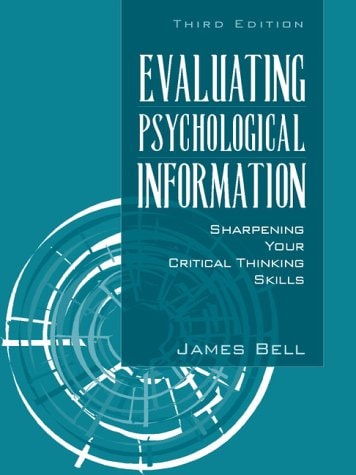
Evaluating Psychological Information: Sharpening Your Critical Thinking Skills
0
0
As an Amazon Associate and affiliate partner, Menrva Books earns from qualifying purchases. Learn more
Author Description
This text provides readers with the intellectual tools necessary to evaluate psychological information and to separate research from opinion and reliable evidence from propaganda. Proposing a four-step procedure, the text focuses on helping students evaluate psychological research and evidence from various (and sometimes incomplete or misleading) secondary sources. Step 1 involves identifying the source; Step 2 teaches how to understand the source by analyzing the central idea (Ch. 3); Step 3 teaches how to identify the source; and Step 4 instructs how to evaluate evidence from psychological research (Ch. 4). Each chapter opens with critical thinking questions and includes examples, practice, and feedback all essential parts of the learning process.
Menrva's Summary
THE THESIS
How can students and researchers effectively distinguish between rigorous psychological evidence and unsubstantiated claims in an era of information overload? James E. Bell provides a structured, four-step pedagogical framework designed to sharpen analytical faculties when encountering psychological literature. By emphasizing the identification of sources, the analysis of central arguments, and the evaluation of empirical evidence, the text equips readers with the methodology required to navigate complex and often misleading secondary information.
THE SCOPE MAP
What You Will Find
- A systematic four-step procedure for evaluating psychological research and secondary sources.
- Practical exercises and critical thinking questions integrated into every chapter.
- Methodologies for identifying propaganda and distinguishing it from reliable scientific evidence.
- Instructional guidance on analyzing the central ideas and logical structure of psychological texts.
THE AUTHORITY PERSPECTIVE
This text serves as a focused, instructional manual for students and practitioners seeking to improve their information literacy within the behavioral sciences. The systematic approach suggests a high degree of utility for undergraduate courses requiring a disciplined method for evaluating academic and popular psychological claims.
Page Count:
64
Publication Date:
1998-07-15
Publisher:
Pearson
ISBN-10:
0205286356
ISBN-13:
9780205286355
Psychology
Psychometrics
Critical thinking
Research Methods
Education
Academic
Community Tags
Other Editions(3)
Similar Books