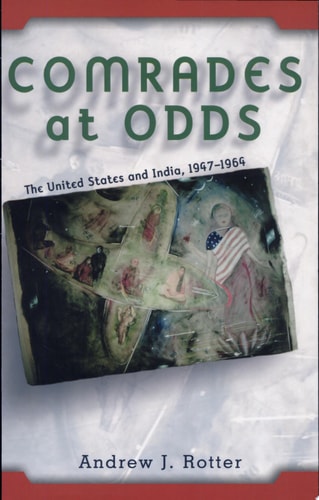
Comrades at Odds: The United States and India, 1947-1964
0
0
As an Amazon Associate and affiliate partner, Menrva Books earns from qualifying purchases. Learn more
Author Description
Comrades at Odds explores the complicated Cold War relationship between the United States and the newly independent India of Jawaharlal Nehru from a unique perspective?that of culture, broadly defined. In a departure from the usual way of doing diplomatic history, Andrew J. Rotter chose culture as his jumping-off point because, he says, "Like the rest of us, policymakers and diplomats do not shed their values, biases, and assumptions at their office doors. They are creatures of culture, and their attitudes cannot help but shape the policy they make." To define those attitudes, Rotter consults not only government documents and the memoirs of those involved in the events of the day, but also literature, art, and mass media. "An advertisement, a photograph, a cartoon, a film, and a short story," he finds, "tell us in their own ways about relations between nations as surely as a State Department memorandum does." While expanding knowledge about the creation and implementation of democracy, Rotter carries his analysis across the categories of race, class, gender, religion, and culturally infused practices of governance, strategy, and economics. Americans saw Indians as superstitious, unclean, treacherous, lazy, and prevaricating. Indians regarded Americans as arrogant, materialistic, uncouth, profane, and violent. Yet, in spite of these stereotypes, Rotter notes the mutual recognition of profound similarities between the two groups; they were indeed "comrades at odds."
Menrva's Summary
THE THESIS
This book investigates the complex cultural underpinnings of the relationship between the United States and India during the formative years of India's independence and the early Cold War. Andrew J. Rotter, drawing on his expertise in diplomatic history and cultural analysis, examines how mutual perceptions, shaped by literature, art, and mass media, influenced policy decisions between 1947 and 1964. The analysis extends to race, class, gender, religion, and governance, revealing a dynamic where deeply ingrained stereotypes of Americans and Indians coexisted with a recognition of shared values, leading to a relationship characterized as 'comrades at odds.'
THE SCOPE MAP
- An examination of the diplomatic history between the United States and India from 1947 to 1964.
- Analysis of the role of culture, broadly defined, in shaping bilateral relations.
- Exploration of how values, biases, and assumptions of policymakers and diplomats influenced policy.
- Consultation of government documents, memoirs, literature, art, and mass media to understand attitudes.
- Discussion of categories such as race, class, gender, and religion in the context of US-India relations.
- An exploration of culturally infused practices of governance, strategy, and economics.
THE AUTHORITY PERSPECTIVE
The book is recognized for its innovative approach to diplomatic history, utilizing cultural analysis as a primary lens to understand the US-India relationship. By incorporating literature, art, and mass media alongside traditional government documents, Rotter offers a nuanced perspective on the period. The work is noted for its detailed exploration of the stereotypes held by each nation towards the other, as well as the underlying similarities that defined their 'comrades at odds' dynamic. This approach provides a richer understanding of the complexities that shaped policy and perception between the two nations during a critical era.
Page Count:
337
Publication Date:
2000-01-01
Publisher:
Cornell University Press
ISBN-10:
080148460X
ISBN-13:
9780801484605
History
Non-Fiction
Cultural History
Indian Studies
American Studies
International relations
Community Tags
Similar Books