This Is Our Message: Women's Leadership in the New Christian Right
0
0
As an Amazon Associate and affiliate partner, Menrva Books earns from qualifying purchases. Learn more
Author Description
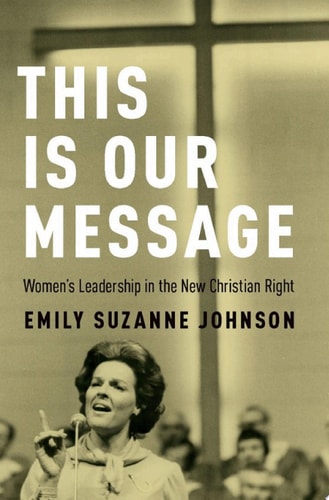
Over the past 50 years, the architects of the religious right have become household names: Jerry Falwell, Pat Robertson, James Dobson. They have used their massively influential platforms to build the profiles of evangelical politicians like Mike Huckabee, Rick Perry, and Ted Cruz. Now, a new generation of leaders like Jerry Falwell Jr. and Robert Jeffress enjoys unprecedented access to the Trump White House.What all these leaders share, besides their faith, is their gender. Men dominate the standard narrative of the rise of the religious right. Yet during the 1970s and 1980s nationally prominent evangelical women played essential roles in shaping the priorities of the movement and mobilizing its supporters. In particular, they helped to formulate, articulate, and defend the traditionalist politics of gender and family that in turn made it easy to downplay the importance of their leadership roles. In This Is Our Message, Emily Johnson begins by examining the lives and work of four well-known women-evangelical marriage advice author Marabel Morgan, singer and anti-gay-rights activist Anita Bryant, author and political lobbyist Beverly LaHaye, and televangelist Tammy Faye Bakker. The book explores their impact on the rise of the New Christian Right and on the development of the evangelical subculture, which is a key channel for injecting conservative political ideas into purportedly apolitical spaces. Johnson then highlights the ongoing significance of this history through an analysis of Sarah Palin's vice presidential candidacy in 2008 and Michele Bachmann's presidential bid in 2012. These campaigns were made possible by the legacies of an earlier generation of conservative evangelical women who continue to impact our national conversations about gender, family, and sex.
Menrva's Summary
THE THESIS
This book investigates the often-overlooked role of prominent evangelical women in constructing and sustaining the political and cultural framework of the New Christian Right. Emily S. Johnson, a historian specializing in American religious history, utilizes archival research and biographical analysis to challenge the male-centric narrative of conservative evangelicalism. She argues that these women were not merely peripheral figures but were instrumental in defining the movement's traditionalist stance on gender and family, which subsequently facilitated their own influence within the subculture.
THE SCOPE MAP
What You Will Find
- Biographical case studies of Marabel Morgan, Anita Bryant, Beverly LaHaye, and Tammy Faye Bakker.
- Analysis of the intersection between evangelical subculture and conservative political mobilization.
- Examination of the political legacies of these figures in the campaigns of Sarah Palin and Michele Bachmann.
Scope Limits
- The text focuses primarily on nationally prominent figures rather than grassroots or local-level leadership.
- The analysis is constrained to the American context of the New Christian Right from the 1970s to the early 2010s.
THE AUTHORITY PERSPECTIVE
Scholars and historians identify this work as a significant contribution to the study of gender dynamics within American religious conservatism. Readers frequently note the academic rigor of the prose and the author's success in re-centering women within a movement traditionally defined by male leadership.
Page Count:
234
Publication Date:
2019-01-01
Publisher:
Oxford University Press
ISBN-10:
0190618957
ISBN-13:
9780190618957
History
Religion
Womens Studies
Special Topics
Evangelicalism
American History
United States
Conservatism
Community Tags
Similar Books