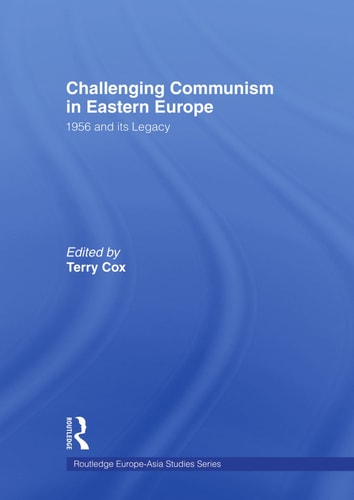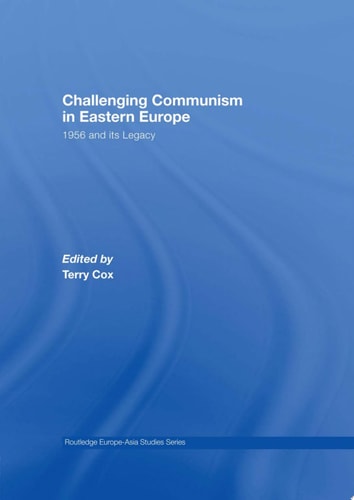
Challenging Communism in Eastern Europe 1956 and its Legacy
0
0
As an Amazon Associate and affiliate partner, Menrva Books earns from qualifying purchases. Learn more
Author Description
Marking the 50th anniversary of events in 1956, that were a major turning point in the history of communist-ruled Eastern Europe, this book contains a selection of some of the most recent research on those momentous events and their memory and legacy. The book contains edited contributions from historians and social scientists from Hungary, Poland the UK and the USA. Their contributions are the fruit of research which has only been possible since 1989. In the years since the fall of the communist regimes the state archives have been opened to researchers and it has been possible to collect the testimony of eye-witnesses without fear of repression and censorship. The outcome of 1956 led to Poland embarking on its own distinctive version of communist rule. Meanwhile 1956 in Hungary saw the first society-wide attempt to overthrow a ruling communist regime – only to be put down by Soviet military intervention. In both countries the events of 1956 had lasting repercussions for society and its relationship with the communist regime. In retrospect they can be seen as paving the way for the eventual fall of the communist regimes in East Central Europe in 1989.
Menrva's Summary
THE THESIS
This book examines the pivotal events of 1956 in Eastern Europe and their enduring impact. Marking the 50th anniversary of these critical moments, the volume presents recent research from historians and social scientists across Hungary, Poland, the UK, and the USA. The research benefits from access to state archives opened after 1989 and the testimony of eyewitnesses, unhindered by repression. The book details how 1956 led Poland to adopt its unique form of communist rule, while Hungary experienced a widespread attempt to overthrow its regime, ultimately suppressed by Soviet intervention. These events profoundly shaped both societies and their relationship with their communist rulers, ultimately paving the way for the fall of communism in 1989.
THE SCOPE MAP
- Analysis of the 1956 events in Hungary and Poland.
- Exploration of the memory and legacy of the 1956 uprisings.
- Contributions from historians and social scientists from Hungary, Poland, the UK, and the USA.
- Research based on post-1989 access to state archives.
- Inclusion of eyewitness testimony collected without fear of repression.
- Discussion of the distinct path of communist rule in Poland post-1956.
- Examination of Hungary's attempt to overthrow its communist regime and Soviet intervention.
THE AUTHORITY PERSPECTIVE
The book offers a collection of recent research on the 1956 events in Eastern Europe, drawing on newly accessible archival materials and eyewitness accounts. The contributions, from scholars in Hungary, Poland, the UK, and the USA, provide a multi-faceted perspective on these pivotal moments and their long-term consequences. The work highlights the distinct trajectories of Poland and Hungary following 1956, emphasizing the lasting repercussions for their societies and their eventual role in the broader collapse of communism. The research is presented as a fruit of the post-1989 era, benefiting from the opening of state archives and the ability to gather testimony without fear of censorship.
Page Count:
224
Publication Date:
2013-09-13
Publisher:
Routledge
ISBN-10:
1317995945
ISBN-13:
9781317995944
History
Non-Fiction
Politics
Eastern Europe