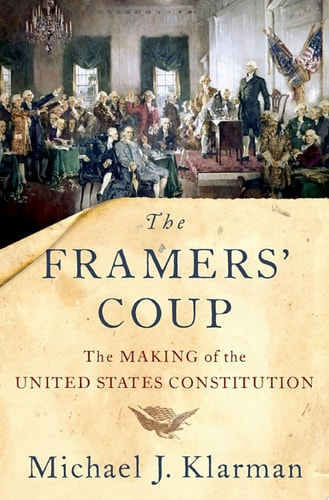
The Framers' Coup: The Making of the United States Constitution
0
0
As an Amazon Associate and affiliate partner, Menrva Books earns from qualifying purchases. Learn more
Author Description
Americans revere their Constitution. However, most of us are unaware how tumultuous and improbable the drafting and ratification processes were. As Benjamin Franklin keenly observed, any assembly of men bring with them "all their prejudices, their passions, their errors of opinion, their local interests and their selfish views." One need not deny that the Framers had good intentions in order to believe that they also had interests. Based on prodigious research and told largely through the voices of the participants, Michael Klarman's The Framers' Coup narrates how the Framers' clashing interests shaped the Constitution--and American history itself.The Philadelphia convention could easily have been a failure, and the risk of collapse was always present. Had the convention dissolved, any number of adverse outcomes could have resulted, including civil war or a reversion to monarchy. Not only does Klarman capture the knife's-edge atmosphere of the convention, he populates his narrative with riveting and colorful stories: the rebellion of debtor farmers in Massachusetts; George Washington's uncertainty about whether to attend; Gunning Bedford's threat to turn to a European prince if the small states were denied equal representation in the Senate; slave staters' threats to take their marbles and go home if denied representation for their slaves; Hamilton's quasi-monarchist speech to the convention; and Patrick Henry's herculean efforts to defeat the Constitution in Virginia through demagoguery and conspiracy theories. The Framers' Coup is more than a compendium of great stories, however, and the powerful arguments that feature throughout will reshape our understanding of the nation's founding. Simply put, the Constitutional Convention almost didn't happen, and once it happened, it almost failed. And, even after the convention succeeded, the Constitution it produced almost failed to be ratified. Just as importantly, the Constitution was hardly the product of philosophical
Menrva's Summary
THE THESIS
This work investigates the core question of how the United States Constitution was produced through a process defined by clashing interests, political maneuvering, and the constant threat of failure. Michael J. Klarman, a professor of constitutional law, utilizes extensive primary source documentation to challenge the traditional narrative of the founding. He argues that the Constitution was not merely a product of philosophical consensus, but rather a result of intense negotiation and strategic compromise among participants driven by their own regional and economic interests.
THE SCOPE MAP
What You Will Find
- Detailed analysis of the Philadelphia Convention and the subsequent ratification process.
- Examination of the economic and political motivations of the delegates.
- Accounts of key historical figures including George Washington, Alexander Hamilton, and Patrick Henry.
- Exploration of the tensions between slave states and free states, as well as large and small states.
Scope Limits
- The text focuses primarily on the political and structural creation of the document rather than a comprehensive legal analysis of its subsequent judicial interpretations.
THE AUTHORITY PERSPECTIVE
Experts and historians frequently highlight this work as a rigorous, demystifying account of the founding era that prioritizes political realism over hagiography. Readers often note the significant density of the prose, which provides a comprehensive and granular look at the legislative hurdles faced by the Framers.
Page Count:
880
Publication Date:
2016-01-01
Publisher:
Oxford University Press
ISBN-10:
0190612215
ISBN-13:
9780190612214
History
American Government
American History
Constitutional Law
United States
Professional Career & Trade
Community Tags
Similar Books