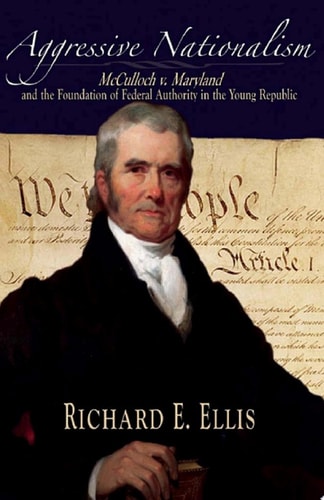
Aggressive Nationalism: McCulloch v. Maryland and the Foundation of Federal Authority in the Young Republic
0
0
As an Amazon Associate and affiliate partner, Menrva Books earns from qualifying purchases. Learn more
Author Description
McCulloch v. Maryland (1819) has long been recognized to be one of the most significant decisions ever handed down by the United States Supreme Court. Indeed, many scholars have argued it is the greatest opinion handed down by the greatest Chief Justice, in which he declared the act creating the Second Bank of the United States constitutional and Maryland's attempt to tax it unconstitutional. Although it is now recognized as the foundational statement for a strong and active federal government, the immediate impact of the ruling was short-lived and widely criticized. Placing the decision and the public reaction to it in their proper historical context, Richard E. Ellis finds that Maryland, though unopposed to the Bank, helped to bring the case before the Court and a sympathetic Chief Justice, who worked behind the scenes to save the embattled institution. Almost all treatments of the case consider it solely from Marshall's perspective, yet a careful examination reveals other, even more important issues that the Chief Justice chose to ignore. Ellis demonstrates that the points which mattered most to the States were not treated by the Court's decision: the private, profit-making nature of the Second Bank, its right to establish branches wherever it wanted with immunity from state taxation, and the right of the States to tax the Bank simply for revenue purposes. Addressing these issues would have undercut Marshall's nationalist view of the Constitution, and his unwillingness to adequately deal with them produced immediate, widespread, and varied dissatisfaction among the States. Ellis argues that Marshall's "aggressive nationalism" was ultimately counter-productive: his overreaching led to Jackson's democratic rejection of the decision and failed to reconcile states' rights to the effective operation of the institutions of federal governance. Elegantly written, full of new information, and the first in-depth examination of McCulloch v. Maryland, Aggressive Nationalism
Menrva's Summary
THE THESIS
Does the Supreme Court decision in McCulloch v. Maryland represent a foundational victory for federal authority or a counter-productive instance of judicial overreach that alienated the states? Richard E. Ellis, a historian specializing in the early American republic, utilizes primary source documents and contemporary legal records to challenge the traditional narrative surrounding the 1819 ruling. He argues that Chief Justice John Marshall’s nationalist agenda ignored critical concerns regarding state sovereignty and the private nature of the Second Bank of the United States, ultimately fostering political instability rather than consensus.
THE SCOPE MAP
What You Will Find
- Historical analysis of the political climate surrounding the Second Bank of the United States.
- Examination of the behind-the-scenes maneuvers by Chief Justice John Marshall.
- Evaluation of the immediate public and state-level reactions to the 1819 Supreme Court ruling.
Scope Limits
- The text does not provide a comprehensive biography of John Marshall.
- The analysis focuses primarily on the immediate aftermath of the ruling rather than long-term constitutional jurisprudence.
THE AUTHORITY PERSPECTIVE
Scholars recognize this work as a critical revisionist study that shifts the focus from a purely legalistic interpretation to a broader political context. Readers frequently note the academic density of the prose and the author's meticulous attention to the neglected grievances of the individual states.
Page Count:
265
Publication Date:
2007-01-01
Publisher:
Oxford University Press
ISBN-10:
0190295864
ISBN-13:
9780190295868
History
19th Century
American History
State Rights
Professional Career & Trade
Legal History
Law_maryland
United States
Constitutional Law
Community Tags
Other Editions(2)

Similar Books



Reader Comments
Share Your Thoughts
No comments yet. Be the first to share your thoughts!