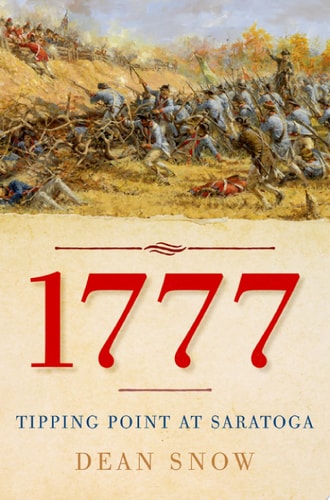
1777: Tipping Point at Saratoga
0
0
As an Amazon Associate and affiliate partner, Menrva Books earns from qualifying purchases. Learn more
Author Description
In the autumn of 1777, near Saratoga, New York, an inexperienced and improvised American army led by General Horatio Gates faced off against the highly trained British and German forces led by General John Burgoyne. The British strategy in confronting the Americans in upstate New York was to separate rebellious New England from the other colonies. Despite inferior organization and training, the Americans exploited access to fresh reinforcements of men and materiel, and ultimately handed the British a stunning defeat. The American victory, for the first time in the war, confirmed that independence from Great Britain was all but inevitable.Assimilating the archaeological remains from the battlefield along with the many letters, journals, and memoirs of the men and women in both camps, Dean Snow's 1777 provides a richly detailed narrative of the two battles fought at Saratoga over the course of thirty-three tense and bloody days. While the contrasting personalities of Gates and Burgoyne are well known, they are but two of the many actors who make up the larger drama of Saratoga. Snow highlights famous and obscure participants alike, from the brave but now notorious turncoat Benedict Arnold to Frederika von Riedesel, the wife of a British major general who later wrote an important eyewitness account of the battles. Snow, an archaeologist who excavated on the Saratoga battlefield, combines a vivid sense of time and place ― with details on weather, terrain, and technology ― and a keen understanding of the adversaries' motivations, challenges, and heroism into a suspenseful, novel-like account. A must-read for anyone with an interest in American history, 1777 is an intimate retelling of the campaign that tipped the balance in the American War of Independence.
Menrva's Summary
THE THESIS
How did the thirty-three days of the Saratoga campaign in 1777 serve as the decisive turning point for the American War of Independence? Dean R. Snow, an archaeologist with extensive field experience at the Saratoga site, synthesizes primary source documents—including letters, journals, and memoirs—with physical evidence from the battlefield. He argues that the American victory was not merely a result of British strategic failure, but a complex interaction of terrain, logistics, and the diverse motivations of the individuals involved in the conflict.
THE SCOPE MAP
What You Will Find
- A detailed chronological account of the two battles at Saratoga over thirty-three days.
- Analysis of the logistical and environmental factors, including weather and terrain, that influenced military outcomes.
- Profiles of key figures including Horatio Gates, John Burgoyne, Benedict Arnold, and Frederika von Riedesel.
Scope Limits
- The text focuses specifically on the Saratoga campaign and does not provide a comprehensive history of the entire American Revolutionary War.
- It does not cover the political developments in London or Philadelphia beyond their direct impact on the battlefield.
THE AUTHORITY PERSPECTIVE
Historians and readers appreciate the author's ability to blend archaeological data with traditional narrative history to create a grounded, physical sense of the battlefield. Experts note that the work provides a high level of detail regarding the daily conditions faced by soldiers and civilians during the campaign.
Page Count:
456
Publication Date:
2016-10-11
Publisher:
Oxford University Press
ISBN-10:
0190618752
ISBN-13:
9780190618759
Biography
History
Archaeology
American Revolution
Military History
Community Tags
Other Editions(4)
Similar Books












Reader Comments
Share Your Thoughts
No comments yet. Be the first to share your thoughts!