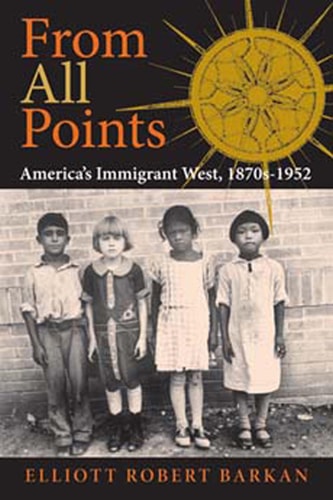
From All Points: America's Immigrant West, 1870s–1952
0
0
As an Amazon Associate and affiliate partner, Menrva Books earns from qualifying purchases. Learn more
Author Description
A history of immigrants in the American West in the nineteenth and twentieth centuries, and their effect on the region. At a time when immigration policy is the subject of heated debate, this book makes clear that the true wealth of America is in the diversity of its peoples. By the end of the twentieth century, the American West was home to nearly half of America's immigrant population, including Asians and Armenians, Germans and Greeks, Mexicans, Italians, Swedes, Basques, and others. This book tells their rich and complex story—of adaptation and isolation, maintaining and mixing traditions, and an ongoing ebb and flow of movement, assimilation, and replenishment. These immigrants and their children built communities, added to the region's culture, and contended with discrimination and the lure of Americanization. The mark of the outsider, the alien, the nonwhite passed from group to group, even as the complexion of the region changed. The region welcomed, then excluded, immigrants, in restless waves of need and nativism that continue to this day. "Written in the fashion of Oscar Handlin, this study makes a convincing case that immigration history comprises an essential part of the history of the American West, and that appreciation of the former and the roles played by myriad alien arrivals is essential for understanding the latter.... Barkan... combines vignettes based on immigrant reminiscences with keen analysis to explore four related themes: various groups' arrivals, their economic influences, their effects on public policy, and their adaptation and assimilation. The resulting narrative is readable and informative.... Recommended." — Choice "A remarkable synthesis of the West as a region of immigrants. It tells the story of how vital immigrants wer
Menrva's Summary
THE THESIS
The American West was shaped by a continuous influx of diverse immigrant populations, whose experiences defined the region's identity and development. Elliott Robert Barkan's work chronicles the complex narratives of immigrants from the 1870s to 1952, detailing their adaptation, assimilation, and the challenges of maintaining traditions amidst societal pressures. The book highlights how these groups, including Asians, Armenians, Germans, Greeks, Mexicans, Italians, Swedes, and Basques, not only built communities and enriched the region's culture but also grappled with discrimination and the evolving concept of Americanization. It examines the cyclical nature of welcome and exclusion driven by economic needs and nativist sentiments, underscoring the enduring impact of immigration on the American West.
THE SCOPE MAP
- A comprehensive history of immigrant groups in the American West from the 1870s to 1952.
- Analysis of the adaptation, isolation, tradition maintenance, and assimilation of various ethnic communities.
- Exploration of the economic contributions and cultural impacts of immigrants on the region.
- Examination of the interplay between immigrant experiences and public policy, including discrimination and nativism.
- Vignettes based on immigrant reminiscences combined with keen analysis.
- Discussion of the changing complexion of the region due to continuous immigration and cultural mixing.
THE AUTHORITY PERSPECTIVE
The book is lauded for its convincing argument that immigration history is integral to understanding the history of the American West, as noted by Choice. Reviewers highlight Barkan's skillful synthesis of immigrant reminiscences with sharp analysis, covering arrival, economic influence, policy impact, and assimilation. The narrative is described as both readable and informative, offering a remarkable synthesis of the West as a region fundamentally shaped by its immigrant populations. It is recommended for its comprehensive exploration of how diverse arrivals contributed to the region's vitality and identity.
Page Count:
624
Publication Date:
2007-05-11
Publisher:
Indiana University Press
ISBN-10:
0253027969
ISBN-13:
9780253027962
Non-Fiction
History
American West
Social History
Cultural History
Immigration
Community Tags
Similar Books