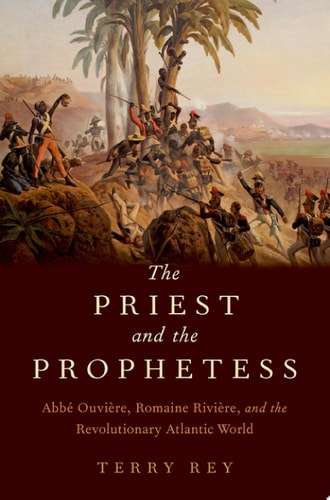
The Priest and the Prophetess
0
0
As an Amazon Associate and affiliate partner, Menrva Books earns from qualifying purchases. Learn more
Author Description
By 1791, the French Revolution had spread to Haïti, where slaves and free blacks alike had begun demanding civil rights guaranteed in the 1789 Declaration of the Rights of Man. Enter Romaine-la-Prophétesse, a free black Dominican coffee farmer who dressed in women's clothes and claimed that the Virgin Mary was his godmother. Inspired by mystical revelations from the Holy Mother, he amassed a large and volatile following of insurgents who would go on to sack countless plantations and conquer the coastal cities of Jacmel and Léogâne. For this brief period, Romaine counted as his political adviser the white French Catholic priest and physician Abbé Ouvière, a renaissance man of cunning politics who would go on to become a pioneering figure in early American science and medicine. Brought together by Catholicism and the turmoil of the revolutionary Atlantic, the priest and the prophetess would come to symbolize the enlightenment ideals of freedom and a more just social order in the eighteenth-century Caribbean. Drawing on extensive archival research, Terry Rey offers a major contribution to our understanding of Catholic mysticism and traditional African religious practices at the time of the Haitian Revolution and reveals the significant ways in which religion and race intersected in the turbulence and triumphs of revolutionary France, Haïti, and early republican America.
Menrva's Summary
THE THESIS
This book investigates the intersection of Catholic mysticism, African religious traditions, and political revolution through the unlikely partnership of a black prophet and a white French priest in 18th-century Haiti. Terry Rey, a scholar of religion and Caribbean history, utilizes extensive archival research to reconstruct the lives of Romaine-la-Prophétesse and Abbé Ouvière. The author argues that their collaboration serves as a lens through which to view the complex interplay of Enlightenment ideals, racial dynamics, and religious syncretism during the Atlantic revolutions.
THE SCOPE MAP
What You Will Find
- Historical analysis of the Haitian Revolution and its connection to the French Revolution
- Examination of the synthesis between Catholic mysticism and traditional African religious practices
- Biographical profiles of Romaine-la-Prophétesse and Abbé Ouvière
- Contextualization of early American science and medicine through the career of Ouvière
Scope Limits
- The narrative is primarily focused on the specific roles and influence of these two individuals rather than a comprehensive military history of the entire Haitian Revolution.
THE AUTHORITY PERSPECTIVE
Scholars and historians recognize this work as a significant contribution to the study of religious and racial intersections in the revolutionary Atlantic. Readers frequently note the depth of the archival research and the clarity with which the author navigates complex theological and political landscapes.
Page Count:
352
Publication Date:
2017-01-01
Publisher:
Oxford University Press
ISBN-10:
0190625856
ISBN-13:
9780190625856
History
Biography
Caribbean History
Religious History
Community Tags
Similar Books