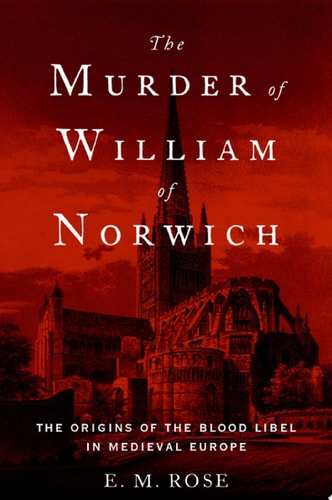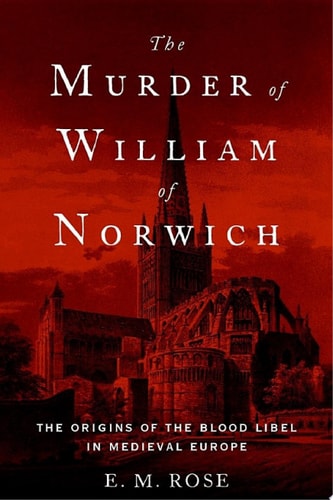
The Murder of William of Norwich: The Origins of the Blood Libel in Medieval Europe
0
0
As an Amazon Associate and affiliate partner, Menrva Books earns from qualifying purchases. Learn more
Author Description
In 1144, the mutilated body of William of Norwich, a young apprentice leatherworker, was found abandoned outside the city's walls. The boy bore disturbing signs of torture, and a story spread that it was a ritual murder, performed by Jews in imitation of the Crucifixion as a mockery of Christianity. The outline of William's tale eventually gained currency far beyond Norwich, and the idea that Jews engaged in ritual murder became firmly rooted in the European imagination.E.M. Rose's engaging book delves into the story of William's murder and the notorious trial that followed to uncover the origin of the ritual murder accusation - known as the "blood libel" - in western Europe in the Middle Ages. Focusing on the specific historical context - 12th-century ecclesiastical politics, the position of Jews in England, the Second Crusade, and the cult of saints - and suspensefully unraveling the facts of the case, Rose makes a powerful argument for why the Norwich Jews (and particularly one Jewish banker) were accused of killing the youth, and how the malevolent blood libel accusation managed to take hold. She also considers four "copycat" cases, in which Jews were similarly blamed for the death of young Christians, and traces the adaptations of the story over time.In the centuries after its appearance, the ritual murder accusation provoked instances of torture, death and expulsion of thousands of Jews and the extermination of hundreds of communities. Although no charge of ritual murder has withstood historical scrutiny, the concept of the blood libel is so emotionally charged and deeply rooted in cultural memory that it endures even today. Rose's groundbreaking work, driven by fascinating characters, a gripping narrative, and impressive scholarship, provides clear answers as to why the blood libel emerged when it did and how it was able to gain such widespread acceptance, laying the foundations for enduring antisemitic myths that continue to the present.
Menrva's Summary
THE THESIS
This book investigates the historical origins of the blood libel accusation, specifically examining how the 1144 death of William of Norwich catalyzed the development of this enduring antisemitic myth. E. M. Rose, a historian specializing in medieval studies, utilizes ecclesiastical records, contemporary chronicles, and legal documents to reconstruct the social and political climate of 12th-century England. She argues that the accusation was not a spontaneous outburst of popular prejudice but a calculated narrative constructed by specific clerical and political actors to serve institutional interests during the Second Crusade.
THE SCOPE MAP
What You Will Find
- Analysis of 12th-century ecclesiastical politics and the cult of saints
- Examination of the socioeconomic position of Jewish communities in medieval England
- Comparative study of four subsequent ritual murder accusations
- Investigation into the role of Jewish financial networks in local power struggles
Scope Limits
- The text does not provide a comprehensive history of all medieval antisemitic tropes
- It focuses primarily on the English context rather than a pan-European survey of every ritual murder case
THE AUTHORITY PERSPECTIVE
Scholars and historians frequently cite this work for its meticulous archival research and its ability to demystify the origins of a complex historical myth. Readers often note the academic rigor of the prose, which balances detailed historical context with a clear, logical progression of the author's central argument.
Page Count:
416
Publication Date:
2015-01-01
Publisher:
Oxford University Press
ISBN-10:
0190219645
ISBN-13:
9780190219642
History
True Crime
Jews europe
European History
Religious History
Jews
Ethnic relations
Antisemitism
Community Tags
Similar Books