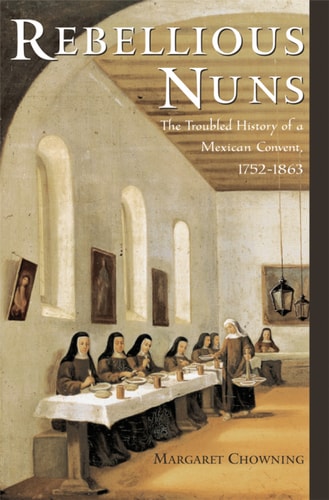
Rebellious Nuns: The Troubled History of a Mexican Convent, 1752-1863
0
0
As an Amazon Associate and affiliate partner, Menrva Books earns from qualifying purchases. Learn more
Author Description
Nuns are hardly associated in the popular mind with rebellion and turmoil. In fact, convents have often been the scenes of conflict, but what went on behind the walls of convents was meant by the church to be mysterious. Great care was taken to prevent the "scandal" of factionalism in the nunneries from becoming widely known. This has made it very difficult to reconstruct the battles fought, the issues debated, and the relationships tested in such convents. Margaret Chowning has discovered a treasure-trove of documents that allow an intimate look at two crises that wracked the convent of La Purísima Concepción in San Miguel el Grande, New Spain (Mexico). At the heart of both rebellions were attempts by some nuns to impose a regimen of strict observance of their vows on the others, and the resistance mounted by those who had a different view of the convent and their own role in it. Would the community adopt as austere a lifestyle as they could endure, doing manual labor, suffering hunger and physical discomfort, deprived of the society of family and friends? Or would these women be allowed to lead comfortable and private lives when not at prayer? Accusations and counteraccusations flew. First one side and then the other seemed to have the upper hand. For a time, a mysterious and dramatic illness broke out among the rebellious nuns, capturing the limelight. Were they faking? Were they unconsciously influenced by their ringleader, the charismatic and manipulative young women who first experienced the "mal"? Rebellious Nuns covers the history of the convent from its founding in 1752 to the forced eviction of the nuns in 1863. While the period of rebellion is at the center of the narrative, Chowning also gives an account of the factors that led up to the crises and the rebellion's continuing repercussions on the convent in the decades to follow. Drawing on an abundance of sources, including numerous letters written by the bishop and local vicar as well as nuns of both fa
Menrva's Summary
THE THESIS
How did internal factionalism and disputes over monastic discipline shape the social and political life of the convent of La Purísima Concepción in San Miguel el Grande between 1752 and 1863? Margaret Chowning, a historian specializing in Latin American history, utilizes a newly discovered cache of primary source documents to reconstruct the power struggles within this cloistered community. Her research argues that these internal conflicts were not merely religious disagreements but reflected broader tensions regarding gender, authority, and the definition of a pious life in colonial and post-colonial Mexico.
THE SCOPE MAP
What You Will Find
- A detailed analysis of the 18th and 19th-century conventual life in New Spain.
- Examination of the ideological divide between strict observance and more moderate, comfortable monastic lifestyles.
- Investigation into the psychological and social dynamics of the 'mal' or mysterious illness that affected the nuns.
- Use of primary source letters from bishops, vicars, and the nuns themselves.
Scope Limits
- The study is geographically limited to the specific convent of La Purísima Concepción.
- The narrative does not attempt to provide a comprehensive history of all Mexican convents during this era.
THE AUTHORITY PERSPECTIVE
Historians and scholars of colonial Mexico frequently cite this work for its rare, intimate access to the internal politics of cloistered women. Readers often note the academic rigor of the prose, which balances detailed archival evidence with a compelling narrative of institutional conflict.
Page Count:
306
Publication Date:
2005-01-01
Publisher:
Oxford University Press
ISBN-10:
019029289X
ISBN-13:
9780190292898
History
Religion
Womens History
Mexico history
Social History
American History
Convents
Colonial History
Mexico
Woman Studies
Religious History
Community Tags
Similar Books