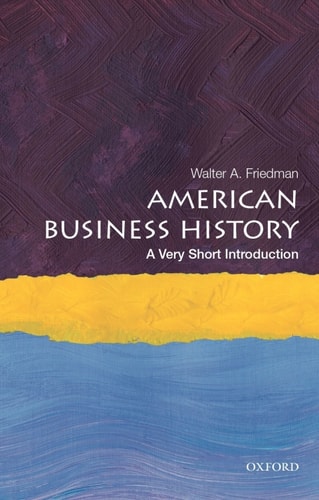
American Business History: A Very Short Introduction (Very Short Introductions)
0
0
As an Amazon Associate and affiliate partner, Menrva Books earns from qualifying purchases. Learn more
Author Description
By the early twentieth century, it became common to describe the United States as a "business civilization." President Coolidge in 1925 said, "The chief business of the American people is business." More recently, historian Sven Beckert characterized Henry Ford's massive manufactory as the embodiment of America: "While Athens had its Parthenon and Rome its Colosseum, the United States had its River Rouge Factory in Detroit..." How did business come to assume such power and cultural centrality in America?This volume explores the variety of business enterprise in the United States and analyzes its presence in the country's economy, its evolution over time, and its meaning in society. It introduces readers to formative business leaders (including Elbert Gary, Harlow Curtice, and Mary Kay Ash), leading firms (Mellon Bank, National Cash Register, Xerox), and fiction about business people (The Octopus, Babbitt, The Man in the Grey Flannel Suit). It also discusses Alfred Chandler, Joseph Schumpeter, Mira Wilkins, and others who made significant contributions to understanding of America's business history. This VSI pursues its three central themes - the evolution, scale, and culture of American business - in a chronological framework stretching from the American Revolution to today. The first theme is evolution: How has U.S. business evolved over time? How have American companies competed with one another and with foreign firms? Why have ideas about strategy and management changed? Why did business people in the mid-twentieth century celebrate an "organizational" culture promising long-term employment in the same company, while a few decades later entrepreneurship was prized?Second is scale: Why did business assume such enormous scale in the United States? Was the rise of gigantic corporations due to the industriousness of its population, or natural resources, or government policies?And third, culture: What are the characteristics of a "business civilization"? How have opin
Menrva's Summary
THE THESIS
How did business come to assume such power and cultural centrality in the United States? Walter A. Friedman, a historian specializing in the development of American business, examines the trajectory of U.S. commerce from the American Revolution to the present day. He utilizes a framework centered on three pillars—evolution, scale, and culture—to analyze how corporate entities, management strategies, and the societal perception of business have shifted over time. The text synthesizes historical data with contributions from prominent economic theorists and business leaders to explain the rise of the American business civilization.
THE SCOPE MAP
What You Will Find
- A chronological analysis of American business from the late 18th century to the modern era.
- Examination of key business figures including Elbert Gary, Harlow Curtice, and Mary Kay Ash.
- Discussion of influential academic contributions from scholars like Alfred Chandler and Joseph Schumpeter.
- Integration of cultural artifacts, including literature such as 'Babbitt' and 'The Man in the Grey Flannel Suit', to illustrate societal attitudes.
Scope Limits
- The text provides a high-level overview rather than an exhaustive deep dive into every specific industry or regional economic history.
- It focuses primarily on the American context, with limited comparative analysis of global business systems outside of competitive trade.
THE AUTHORITY PERSPECTIVE
Readers frequently note the accessibility of this volume, which serves as a concise entry point for students and general readers interested in economic history. Experts highlight the author's ability to distill complex organizational and cultural shifts into a coherent, manageable narrative.
Page Count:
176
Publication Date:
2020-01-01
Publisher:
Oxford University Press
ISBN-10:
0190622504
ISBN-13:
9780190622503
Non-Fiction
Economics
Business
History
American History
Macroeconomic Theory
Economics history
History of the Americas
Community Tags
Similar Books