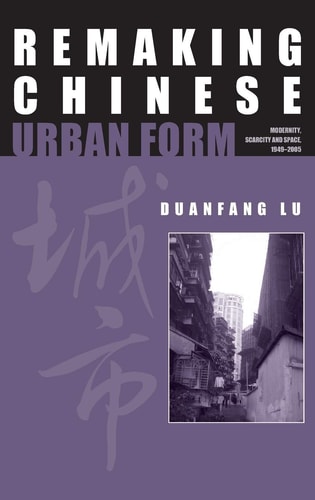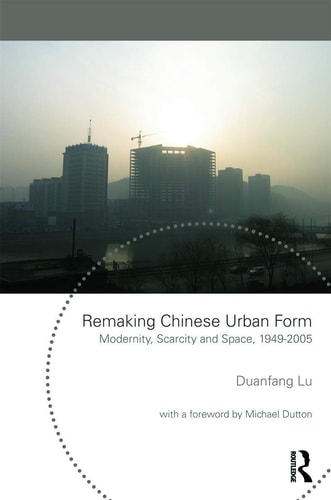
Remaking Chinese Urban Form: Modernity, Scarcity and Space, 1949-2005
0
0
As an Amazon Associate and affiliate partner, Menrva Books earns from qualifying purchases. Learn more
Author Description
In this pioneering study of contemporary Chinese urban form, Duanfang Lu provides an analysis of how Chinese society constructed itself through the making and remaking of its built environment. Drawing on archival documents, professional journals and her own fieldwork, she explores hitherto overlooked issues including the history of China¿s residential planning paradigms and the development of the work unit as an urban form. Lu shows how China¿s quest for modernity created a perpetual scarcity as both a social reality and a national imagination. Although planners attempted to apply modern planning techniques to the city, the realization of planning ideals was postponed. The conflicting relationship between scarcity and the socialist system created specific spatial strategies. The work unit ¿ the socialist enterprise or institute ¿ gradually developed from workplace to social institution which integrated work, housing and social services. The Chinese city achieved a unique morphology made up in large part of self-contained work units. Today, when the Chinese city has revealed its many faces, Remaking Chinese Urban Form presents a refreshing panorama of the nation¿s mixed experiences with socialist and Third World modernity which is both timely and provocative.
Menrva's Summary
THE THESIS
This book investigates how the built environment in China was constructed and reconstructed to embody its pursuit of modernity and grapple with perpetual scarcity from 1949 to 2005. Duanfang Lu analyzes the evolution of China's urban form, focusing on residential planning paradigms and the development of the 'work unit' as a distinct urban morphology. The study reveals how the socialist system and the concept of scarcity influenced spatial strategies, leading to cities largely composed of self-contained work units that integrated living, working, and social services. The book offers a panoramic view of China's complex engagement with socialist and Third World modernity through its urban development.
THE SCOPE MAP
- Analysis of Chinese urban form from 1949 to 2005
- Exploration of residential planning paradigms
- Development of the 'work unit' as an urban form
- Examination of the interplay between modernity, scarcity, and spatial strategies
- Use of archival documents, professional journals, and fieldwork
- Discussion of the realization of planning ideals versus socialist realities
- Unique morphology of Chinese cities comprised of self-contained work units
THE AUTHORITY PERSPECTIVE
This book is recognized for its pioneering analysis of contemporary Chinese urban form, offering a unique perspective on how societal constructs shaped the built environment. It is particularly noted for its exploration of overlooked aspects like residential planning and the 'work unit' as a key urban element. The work is considered timely and provocative for its examination of China's experiences with modernity and scarcity. Its detailed research, drawing from archival sources and fieldwork, provides a solid foundation for understanding the complexities of Chinese urban development.
Page Count:
204
Publication Date:
2011-04-04
Publisher:
Routledge
ISBN-10:
0415665698
ISBN-13:
9780415665698
Non-Fiction
History
Architecture
Sociology
urban planning