Cricket in Colonial India 1780–1947
0
0
As an Amazon Associate and affiliate partner, Menrva Books earns from qualifying purchases. Learn more
Author Description
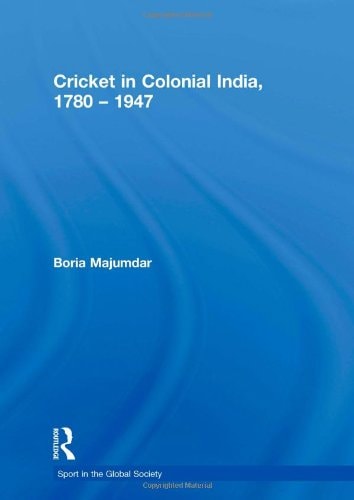
This is an exacting social history of Indian cricket between 1780 and 1947. It considers cricket as a derivative sport, creatively adapted to suit modern Indian socio-cultural needs, fulfil political imperatives and satisfy economic aspirations. Majumdar argues that cricket was a means to cross class barriers and had a healthy following even outside the aristocracy and upper middle classes well over a century ago. Indeed, in some ways, the democratization of the sport anticipated the democratization of the Indian polity itself. Boria Majumdar reveals the appropriation, assimilation and subversion of cricketing ideals in colonial and post-colonial India for nationalist ends. He exposes a sport rooted in the contingencies of the colonial and post-colonial context of nineteenth- and twentieth-century India. Cricket, to put it simply, is much more than a ‘game’ for Indians. This study describes how the genealogy of their intense engagement with cricket stretches back over a century. It is concerned not only with the game but also with the end of cricket as a mere sport, with Indian cricket’s commercial revolution in the 1930s, with ideals and idealism and their relative unimportance, with the decline of morality for reasons of realpolitik, and with the denunciation, once and for all, of the view that sport and politics do not mix. This book was previously published as a special issue of the International Journal of the History of Sport
Menrva's Summary
THE THESIS
This book investigates the complex social, political, and economic evolution of cricket in India from 1780 to 1947. Boria Majumdar, a noted historian of sport, examines cricket not merely as a game but as a tool for social mobility, political expression, and economic advancement within the colonial Indian context. The study utilizes historical records and socio-cultural analysis to argue that cricket's adaptation and popularization anticipated broader democratic movements in India. Majumdar posits that the sport became a significant vehicle for nationalist aspirations, demonstrating how its ideals were appropriated, assimilated, and sometimes subverted to serve political ends.
THE SCOPE MAP
- The adaptation of cricket to suit Indian socio-cultural needs and political imperatives.
- Cricket's role in crossing class barriers and its following beyond the elite.
- The appropriation, assimilation, and subversion of cricketing ideals for nationalist purposes.
- The sport's deep roots in the colonial and post-colonial context of 19th and 20th century India.
- The commercial revolution of Indian cricket in the 1930s.
- The interplay between ideals, morality, and realpolitik in the sport.
- The inextricable link between sport and politics in the Indian experience.
THE AUTHORITY PERSPECTIVE
This book is regarded as an exacting social history that delves deeply into the origins and evolution of cricket in India during the colonial era. Scholars and readers have noted its comprehensive scope, tracing the sport's transformation from an elite pastime to a democratized national passion. The analysis highlights how cricket became intertwined with India's socio-cultural fabric and political aspirations, serving as a lens through which to understand broader societal changes. The work is recognized for its detailed examination of how the sport was adapted and utilized for nationalist ends, challenging simplistic views of sport and politics as separate spheres.
Page Count:
196
Publication Date:
2008-05-02
Publisher:
Routledge
ISBN-10:
0415400147
ISBN-13:
9780415400145
History
Non-Fiction
Sports
Social History
Colonial India
Community Tags
Similar Books