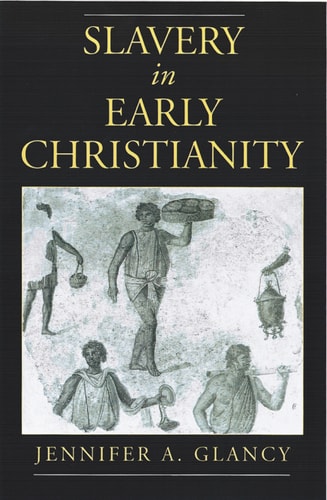
Slavery in Early Christianity
0
0
As an Amazon Associate and affiliate partner, Menrva Books earns from qualifying purchases. Learn more
Author Description
Slavery was widespread throughout the Mediterranean lands where Christianity was born and developed. Though Christians were both slaves and slaveholders, there has been surprisingly little study of what early Christians thought about the realities of slavery. How did they reconcile slavery with the Gospel teachings of brotherhood and charity? Slaves were considered the sexual property of their owners: what was the status within the Church of enslaved women and young male slaves who were their owners' sexual playthings? Is there any reason to believe that Christians shied away from the use of corporal punishments so common among ancient slave owners? Jennifer A. Glancy brings a multilayered approach to these and many other issues, offering a comprehensive re-examination of the evidence pertaining to slavery in early Christianity. Drawing on a wide variety of sources, Glancy situates early Christian slavery in its broader cultural setting. She argues that scholars have consistently underestimated the pervasive impact of slavery on the institutional structures, ideologies, and practices of the early churches and of individual Christians. The churches, she shows, grew to maturity with the assumption that slaveholding was the norm, and welcomed both slaves and slaveholders as members. Glancy draws attention to the importance of the body in the thought and practice of ancient slavery. To be a slave was to be a body subject to coercion and violation, with no rights to corporeal integrity or privacy. Even early Christians who held that true slavery was spiritual in nature relied, ultimately, on bodily metaphors to express this. Slavery, Glancy demonstrates, was an essential feature of both the physical and metaphysical worlds of early Christianity. The first book devoted to the early Christian ideology and practice of slavery, this work sheds new light on the world of the ancient Mediterranean and on the development of the early Church.
Menrva's Summary
THE THESIS
This work investigates how the institution of slavery shaped the institutional structures, ideologies, and practices of early Christianity within the ancient Mediterranean world. Jennifer A. Glancy, a scholar of early Christian history, utilizes a multidisciplinary approach to examine the intersection of Gospel teachings and the pervasive reality of slaveholding. She argues that early churches normalized slavery, integrating both slaves and slaveholders into their communities while relying on bodily metaphors that reflected the physical realities of the era.
THE SCOPE MAP
What You Will Find
- Analysis of the social and legal status of enslaved persons in the Roman Mediterranean
- Examination of the intersection between Christian theology and corporal punishment
- Investigation into the sexual exploitation of enslaved individuals within early Christian contexts
- Evaluation of the use of bodily metaphors in early Christian literature
Scope Limits
- The study focuses primarily on the early Christian period and does not extend to later medieval or modern developments of slavery
- The work does not provide a comprehensive history of Roman law, but rather focuses on the specific interaction between Christian practice and existing slaveholding norms
THE AUTHORITY PERSPECTIVE
Scholars recognize this work as a significant contribution to the study of early Christian social history, particularly for its focus on the physical realities of the enslaved body. Readers frequently note the academic rigor and the challenging nature of the evidence presented regarding the normalization of slavery within the early Church.
Page Count:
217
Publication Date:
2002-01-01
Publisher:
Oxford University Press
ISBN-10:
0190285745
ISBN-13:
9780190285746
Religion
History
Church And Social Problems
Christianity
Sociology of Religion
Ancient History
Social History
Slavery and the church
Community Tags
Other Editions(4)


Similar Books











Reader Comments
Share Your Thoughts
No comments yet. Be the first to share your thoughts!