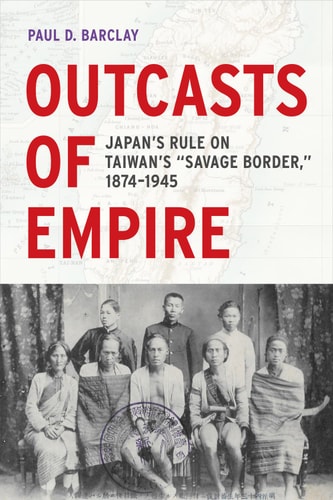
Outcasts of Empire: Japan's Rule on Taiwan's "Savage Border," 1874-1945
0
0
As an Amazon Associate and affiliate partner, Menrva Books earns from qualifying purchases. Learn more
Author Description
A free ebook version of this title is available through Luminos, University of California Press’s Open Access publishing program. Visit www.luminosoa.org to learn more. Outcasts of Empire unveils the causes and consequences of capitalism’s failure to “batter down all Chinese walls” in modern Taiwan. Adopting micro- and macrohistorical perspectives, Paul D. Barclay argues that the interpreters, chiefs, and trading-post operators who mediated state-society relations on Taiwan’s “savage border” during successive Qing and Japanese regimes rose to prominence and faded to obscurity in concert with a series of “long nineteenth century” global transformations. Superior firepower and large economic reserves ultimately enabled Japanese statesmen to discard mediators on the border and sideline a cohort of indigenous headmen who played both sides of the fence to maintain their chiefly status. Even with reluctant “allies” marginalized, however, the colonial state lacked sufficient resources to integrate Taiwan’s indigenes into its disciplinary apparatus. The colonial state therefore created the Indigenous Territory, which exists to this day as a legacy of Japanese imperialism, local initiatives, and the global commodification of culture.
Menrva's Summary
THE THESIS
This book investigates the complex interactions between Japanese colonial rule and the indigenous populations of Taiwan's "savage border" from 1874 to 1945. Paul D. Barclay examines how mediators like interpreters, chiefs, and trading-post operators navigated state-society relations during Qing and Japanese regimes, their fortunes tied to global economic and political shifts. The narrative details how Japanese authorities eventually sidelined these mediators and indigenous headmen, despite lacking the resources to fully integrate the indigenous peoples into their colonial system. Ultimately, this led to the creation of the Indigenous Territory, a lasting legacy of Japanese imperialism, local agency, and global cultural commodification.
THE SCOPE MAP
- Analysis of the causes and consequences of capitalism's limited penetration into Taiwan's "savage border" under Japanese rule.
- Exploration of the roles and influence of mediators (interpreters, chiefs, trading-post operators) in state-society relations.
- Examination of the impact of "long nineteenth century" global transformations on local power structures.
- Details on how superior Japanese military and economic power led to the marginalization of mediators and indigenous headmen.
- Discussion of the colonial state's resource limitations in integrating indigenous populations.
- The establishment and legacy of the Indigenous Territory as a product of imperialism, local initiatives, and cultural commodification.
THE AUTHORITY PERSPECTIVE
The book is presented as a detailed historical analysis, utilizing both micro- and macrohistorical perspectives to understand the complex dynamics of colonial rule and indigenous resistance. The author's argument centers on the failure of capitalism to fully penetrate and control the border regions, leading to the creation of unique administrative structures like the Indigenous Territory. The work appears to offer a nuanced view of colonial power, acknowledging the agency of indigenous groups and the limitations of the state. Its focus on mediators and the lasting impact of imperial policies suggests a scholarly examination of historical processes and their enduring consequences.
Page Count:
328
Publication Date:
2017-10-24
Publisher:
University of California Press
ISBN-10:
0520968808
ISBN-13:
9780520968806
History
Non-Fiction
Colonialism
Cultural History
Taiwan
Capitalism
Community Tags
Similar Books