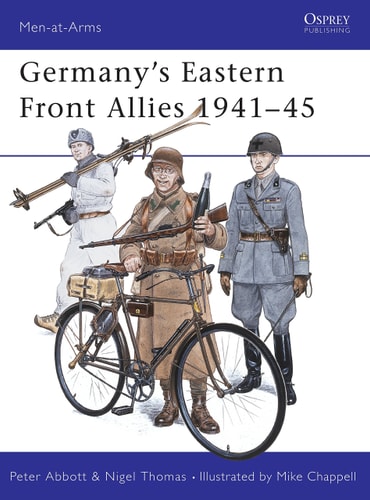
Germany's Eastern Front Allies 1941–45
0
0
As an Amazon Associate and affiliate partner, Menrva Books earns from qualifying purchases. Learn more
Author Description
The 1930s were a time of growing tension for the smaller states of Eastern Europe. Since the end of the First World War they had enjoyed an independence which most of them had not known for centuries, but this was now threatened by the growing power of Nazi Germany and Soviet Russia. Instead of combining for self defence, they were bitterly divided. The Munich crisis of 1938, which served as the prelude to World War II, showed how little reliance could be placed on the Western democracies, whose power to intervene militarily in Eastern Europe was negligible. In effect this left the smaller East European states with little alternative but to become clients of either Germany or Russia.
Menrva's Summary
THE THESIS
The Eastern Front of World War II saw numerous nations align with Nazi Germany, often under duress or with complex motivations. This book examines the military contributions and experiences of these allied states, including Romania, Hungary, Finland, and others, detailing their campaigns, equipment, and the internal political pressures they faced. It explores the shifting alliances and the ultimate fate of these nations as the tide of war turned against Germany, providing a comprehensive overview of their involvement from 1941 to 1945.
THE SCOPE MAP
- Detailed examination of the military forces of Romania, Hungary, Finland, Slovakia, Croatia, and Bulgaria.
- Analysis of their campaigns and battles on the Eastern Front, from the initial invasion of the Soviet Union to the final German retreats.
- Information on the organization, uniforms, and equipment used by these allied armies.
- Discussion of the political and strategic contexts that shaped their involvement with Germany.
- Insights into the motivations and experiences of soldiers fighting alongside the Wehrmacht.
- Coverage of the period from the invasion of the Soviet Union in 1941 to the end of the war in Europe in 1945.
THE AUTHORITY PERSPECTIVE
This work is regarded as a detailed and informative account of the often-overlooked allied forces fighting with Germany on the Eastern Front. The authors' focus on the military aspects, including equipment and campaigns, provides valuable insights for historians and enthusiasts of World War II. The book is noted for its comprehensive coverage of multiple nations and their complex roles in the conflict. It serves as a solid reference for understanding the diverse military landscape of the Eastern Front.
Page Count:
48
Publication Date:
1982-11-25
Publisher:
Bloomsbury USA
ISBN-10:
0850454751
ISBN-13:
9780850454758
History
Non-Fiction
Military History
Eastern Europe
Community Tags
Similar Books