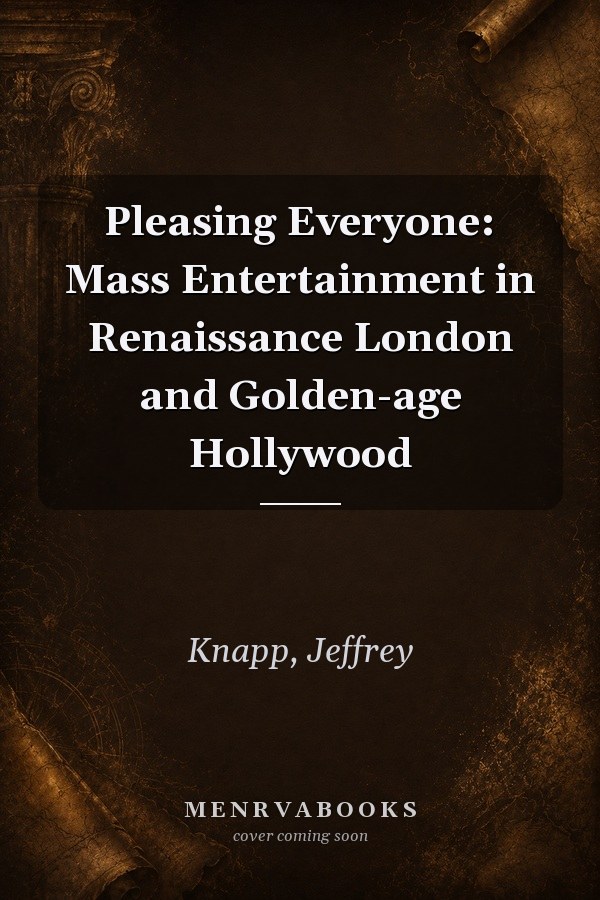
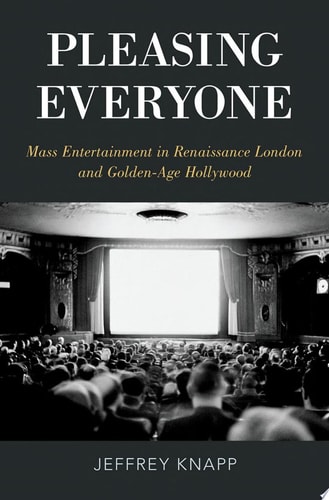
Pleasing Everyone: Mass Entertainment in Renaissance London and Golden-age Hollywood
0
0
As an Amazon Associate and affiliate partner, Menrva Books earns from qualifying purchases. Learn more
Author Description
Shakespeare's Plays Were Immensely Popular In Their Own Day -- So Why Do We Refuse To Think Of Them As Mass Entertainment? In Pleasing Everyone, Jeffrey Knapp Opens Our Eyes To The Uncanny Resemblance Between Renaissance Drama And The Incontrovertibly Mass Medium Of Golden-age Hollywood Cinema. Through Fascinating Explorations Of Such Famous Plays As Hamlet, The Roaring Girl, And The Alchemist, And Such Celebrated Films As Citizen Kane, The Jazz Singer, And City Lights, Knapp Challenges Some Of Our Most Basic Assumptions About The Relationship Between Art And Mass Audiences. Above All, Knapp Encourages Us To Resist The Prejudice That Mass Entertainment Necessarily Simplifies And Cheapens Whatever It Touches. As Knapp Shows, It Was Instead The Ceaseless Pressure To Please Everyone That Helped Generate The Astonishing Richness And Complexity Of Renaissance Drama As Well As Of Hollywood Film-- Machine Generated Contents Note: -- Introduction -- Part 1: The Individual And The Mass -- 1. Which Moll? -- 2. The Real John Doe -- Part 2: Show Business -- 3. I Must Be Idle -- 4. One Step Ahead Of My Shadow -- Part 3: Junk And Art -- 5. Mocked With Art -- 6. Throw That Junk -- Epilogue: The Author Of Mass Entertainment -- Coda: A Second Look -- Notes -- Works Cited. Jeffrey Knapp. Includes Bibliographical References And Index.
Menrva's Summary
THE THESIS
This book investigates the historical and aesthetic parallels between Renaissance drama and Golden-age Hollywood cinema to challenge the assumption that mass entertainment inherently diminishes artistic quality. Jeffrey Knapp, a professor of English, utilizes a comparative framework to argue that the commercial pressure to appeal to broad, diverse audiences actually served as a catalyst for the complexity and depth found in both Shakespearean plays and classic American films. By examining specific works from both eras, he demonstrates that the pursuit of mass popularity often fostered innovation rather than simplification.
THE SCOPE MAP
What You Will Find
- Comparative analysis of Renaissance plays including Hamlet, The Roaring Girl, and The Alchemist.
- Critical examination of Hollywood films such as Citizen Kane, The Jazz Singer, and City Lights.
- A thematic exploration of the relationship between individual artistic intent and mass-market appeal.
Scope Limits
- The analysis does not cover post-Golden-age cinema or contemporary mass media trends.
- The study focuses primarily on English-language drama and American film, excluding broader global theatrical or cinematic traditions.
THE AUTHORITY PERSPECTIVE
Scholars and critics frequently note the book's ability to bridge the gap between early modern studies and film theory with rigorous, accessible prose. Experts highlight this work as a significant contribution to the ongoing debate regarding the intersection of commercial viability and high-art status in historical contexts.
Page Count:
0
Publication Date:
1900-01-01
Publisher:
Oxford University Press,
ISBN-10:
019063409X
ISBN-13:
9780190634094
History
Film Studies
Motion pictures
Theater
Literary Criticism
Theater And Society
Social Aspects
Community Tags
Other Editions(2)
Similar Books