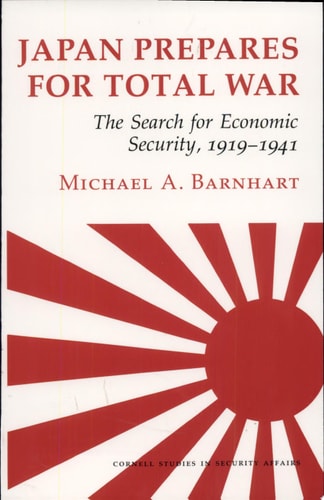
Japan Prepares for Total War: The Search for Economic Security, 1919–1941
0
0
As an Amazon Associate and affiliate partner, Menrva Books earns from qualifying purchases. Learn more
Author Description
The roots of Japan's aggressive, expansionist foreign policy have often been traced to its concern over acute economic vulnerability. Historian Michael Barnhart tests this assumption by examining the events leading up to World War II in the context of Japan's quest for economic security. Drawing on a wide array of Japanese and American sources, this is the first English-language book on the war's origins to be based on research in archives on both sides of the Pacific. Barnhart focuses on the critical years from 1938 to 1941 as he investigates the development of Japan's drive for national economic self-sufficiency and independence and the way in which this drive shaped its internal and external policies. He also explores American economic pressure on Tokyo and assesses its impact on Japan's foreign policy and domestic economy. He concludes that Japan's internal political dynamics, especially the bitter rivalry between its army and navy, played a far greater role in propelling the nation into war with the United States than did its economic condition or even pressure from Washington. Japan Prepares for Total War sheds new light on prewar Japan and confirms the opinions of those in Washington who advocated economic pressure against Japan. At a time of growing interest in U.S.-Japanese economic relations, this book will be stimulating and provocative reading for scholars and students of international relations and American and Asian history.
Menrva's Summary
THE THESIS
This book investigates the extent to which Japan's pursuit of economic security, rather than inherent economic vulnerability, drove its aggressive foreign policy leading up to World War II. Michael A. Barnhart, a historian, examines the critical years from 1938 to 1941, analyzing Japan's efforts to achieve national economic self-sufficiency and independence and how these efforts influenced its domestic and foreign policies. The study also scrutinizes American economic pressure on Japan and its repercussions. Barnhart posits that internal political dynamics, particularly the army-navy rivalry, were more significant in Japan's decision to enter the war than its economic condition or external pressure.
THE SCOPE MAP
- Analysis of Japan's quest for economic self-sufficiency and independence from 1919 to 1941.
- Examination of the impact of American economic pressure on Japan's foreign and domestic policies.
- Exploration of the internal political dynamics, specifically the army-navy rivalry, as a driver of war.
- Research based on archives from both Japan and the United States.
- Assessment of the relationship between economic conditions and Japan's expansionist foreign policy.
THE AUTHORITY PERSPECTIVE
This book is regarded as a significant contribution to understanding the origins of World War II in the Pacific, particularly concerning Japan's motivations. It challenges the prevailing assumption that Japan's expansionism was solely driven by economic vulnerability, instead highlighting the role of its proactive search for economic security. The research, drawing on extensive archival material from both sides of the Pacific, offers a nuanced perspective on the interplay between internal politics, economic policy, and foreign relations. Scholars and students of international relations and Asian history find its analysis of U.S.-Japanese economic relations and Japan's internal political dynamics to be particularly stimulating and provocative.
Page Count:
290
Publication Date:
1987-01-01
Publisher:
Cornell University Press
ISBN-10:
0801495296
ISBN-13:
9780801495298
Non-Fiction
History
International relations
Asian History
Military History
Economic History
Community Tags
Similar Books