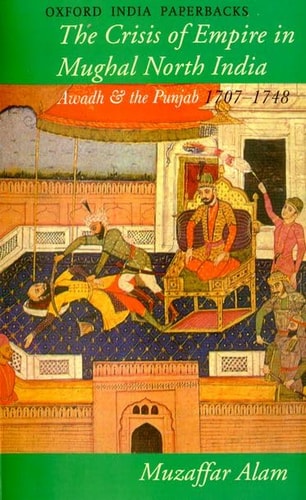
The Crisis of Empire in Mughal North India: Awadh and the Punjab 1707-1748
0
0
As an Amazon Associate and affiliate partner, Menrva Books earns from qualifying purchases. Learn more
Author Description
The collapse of the Mughal empire has often been characterized as a period of political fragmentation, social unrest, and economic decay. Contrasting two regions in north India--Awadh and the Punjab--Muzaffar Alam contends that even as the empire declined, there emerged a new,regionally-based political order, maintained and controlled by former Mughal rulers. From agrarian uprisings to the jagiardari system, the Sikhs to the Zamindars, this book presents a bold new interpretation of an important transition in Indian government.
Menrva's Summary
THE THESIS
This work investigates the nature of the Mughal Empire's decline by examining whether the period was defined solely by decay or by the emergence of new, regionally-based political structures. Muzaffar Alam, a distinguished historian of early modern India, utilizes extensive archival research and administrative records to challenge traditional historiography. He argues that the transition in Awadh and the Punjab represented a complex reconfiguration of power rather than a simple collapse of central authority. By analyzing the interplay between local agrarian interests and imperial administration, the author provides a nuanced framework for understanding the evolution of regional governance during the eighteenth century.
THE SCOPE MAP
What You Will Find
- Comparative analysis of political and economic developments in the Awadh and Punjab regions between 1707 and 1748.
- Detailed examination of the jagirdari system and its impact on provincial stability.
- Assessment of the roles played by local actors, including the Sikhs and various zamindar factions, in shaping regional power dynamics.
- Investigation into the mechanisms of agrarian uprisings and their influence on the shifting Mughal administrative apparatus.
THE AUTHORITY PERSPECTIVE
Historians and scholars of South Asian studies frequently cite this work as a foundational text for understanding the complexities of the late Mughal period. Readers often note the academic density of the prose, which provides a rigorous and highly detailed analysis of regional political transitions.
Page Count:
384
Publication Date:
1993-10-21
Publisher:
Oxford University Press
ISBN-10:
0195630009
ISBN-13:
9780195630008
History
Asian History
Political History
India
Economic History