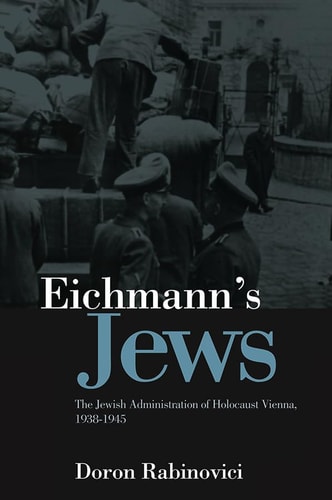
Eichmann's Jews: The Jewish Administration of Holocaust Vienna, 1938-1945
0
0
As an Amazon Associate and affiliate partner, Menrva Books earns from qualifying purchases. Learn more
Author Description
The question of the collaboration of Jews with the Nazi regime during the persecution and extermination of European Jewry is one of the most difficult and sensitive issues surrounding the Holocaust. How could people be forced to cooperate in their own destruction? Why would they help the Nazi authorities round up their own people for deportation, manage the 'collection points' and supervise the people being deported until the last moment? This book is a major new study of the role of the Jews, and more specifically the 'Judenrat' or Jewish Council, in Holocaust Vienna. It was in Vienna that Eichmann developed and tested his model for a Nazi Jewish policy from 1938 onwards, and the leaders of the Viennese Jewish community were the prototypes for all subsequent Jewish councils. By studying the situation in Vienna, it is possible to gain a unique insight into the way that the Nazi regime incorporated the Jewish community into its machinery of destruction. Drawing on recently discovered archives and extensive interviews, Doron Rabinovici explores in detail the actions of individual Jews and Jewish organizations and shows how all of their strategies to protect themselves and others were ultimately doomed to failure. His rich and insightful account enables us to understand in a new way the terrible reality of the victims' plight: faced with the stark choice of death or cooperation, many chose to cooperate with the authorities in the hope that their actions might turn out to be the lesser evil.
Menrva's Summary
THE THESIS
This book investigates the complex and ethically fraught question of Jewish participation in the administration of their own persecution within Nazi-occupied Vienna. It examines how Jewish leaders, particularly the Judenrat, were compelled to cooperate with the Nazi regime in Vienna, the testing ground for Eichmann's policies, and how this cooperation was integrated into the machinery of destruction. Drawing on extensive archival research and interviews, the study details the strategies employed by individuals and organizations, ultimately highlighting their tragic futility in the face of overwhelming oppression.
THE SCOPE MAP
- The development and implementation of Nazi Jewish policy in Vienna, 1938-1945.
- The role and function of the Judenrat (Jewish Council) in Holocaust administration.
- Analysis of recently discovered archives and extensive interviews.
- Exploration of individual Jews' and Jewish organizations' actions and strategies.
- The ethical dilemmas and forced choices faced by the Jewish community.
- The Viennese Jewish community as a prototype for subsequent Jewish councils under Nazi rule.
THE AUTHORITY PERSPECTIVE
This significant historical study delves into one of the most challenging aspects of the Holocaust: Jewish involvement in their own persecution. The book is recognized for its detailed examination of the Viennese Judenrat's role, which served as a model for Nazi policy across Europe. By analyzing newly accessible archives and conducting extensive interviews, Rabinovici provides a nuanced understanding of the impossible choices faced by victims. The work is noted for its insightful account of how cooperation, however coerced, became intertwined with the Nazi extermination apparatus, offering a new perspective on the victims' plight.
Page Count:
288
Publication Date:
2011-10-17
Publisher:
Polity Press
ISBN-10:
0745646824
ISBN-13:
9780745646824
Non-Fiction
History
Jewish Studies
Jewish History
Community Tags
Similar Books