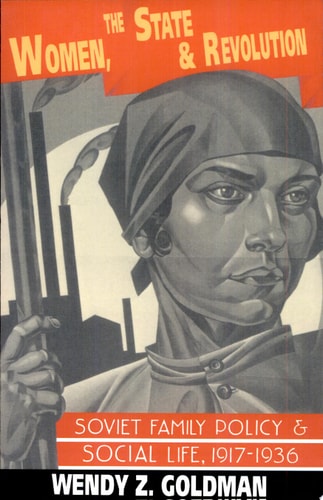
Women, the State and Revolution: Soviet Family Policy and Social Life, 1917-1936
0
0
As an Amazon Associate and affiliate partner, Menrva Books earns from qualifying purchases. Learn more
Author Description
When the Bolsheviks came to power in 1917, they believed that under socialism the family would "wither-away." They envisioned a society in which communal dining halls, daycare centers, and public laundries would replace the unpaid labor of women in the home. Yet by 1936 legislation designed to liberate women from their legal and economic dependence had given way to increasingly conservative solutions aimed at strengthening traditional family ties and women's reproductive role. This book explains the reversal, focusing on how women, peasants, and orphans responded to Bolshevik attempts to remake the family, and how their opinions and experiences in turn were used by the state to meet its own needs.
Menrva's Summary
THE THESIS
The Bolshevik vision of a socialist society initially aimed to dismantle the traditional family structure, but this ideal rapidly transformed into a conservative policy by 1936. The early Soviet state believed that communal services would liberate women from domestic labor, yet the reality of family life and the state's evolving needs led to a significant policy reversal. This book examines the complex interplay between state policy, women's experiences, and the evolving concept of the family in Soviet Russia between 1917 and 1936, detailing how the state adapted its approach based on the responses of women, peasants, and orphans.
THE SCOPE MAP
- The ideological underpinnings of early Bolshevik family policy and its goal of replacing the traditional family.
- The practical implementation of communal services and their impact on women's lives.
- The shift towards conservative family policies and the strengthening of traditional family ties.
- The role of women, peasants, and orphans in shaping and responding to state family initiatives.
- An analysis of how the Soviet state utilized the experiences and opinions of its citizens to meet its own evolving needs.
- The legal and social changes in family law and women's reproductive roles between 1917 and 1936.
THE AUTHORITY PERSPECTIVE
This historical analysis is regarded as a significant contribution to understanding Soviet social policy and the complexities of gender roles during the early Soviet period. Scholars have noted its detailed examination of how state ideology interacted with the lived experiences of ordinary citizens, particularly women, peasants, and orphans. The book is praised for its nuanced portrayal of the reversal from radical social experimentation to more traditional family structures. Its focus on the agency of various social groups in shaping policy provides a critical perspective on the Soviet state's attempts to remake society.
Page Count:
351
Publication Date:
1993-11-26
Publisher:
Cambridge University Press
ISBN-10:
0521458161
ISBN-13:
9780521458160
History
Non-Fiction
Russian History
Social History
Community Tags
Similar Books