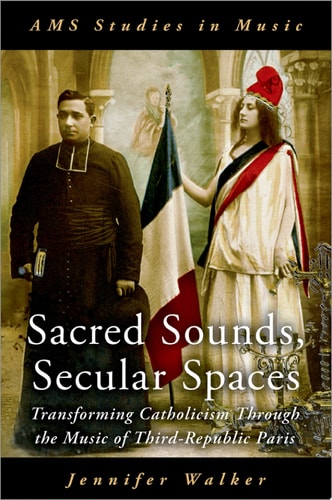
Sacred Sounds, Secular Spaces: Transforming Catholicism Through the Music of Third-Republic Paris
0
0
As an Amazon Associate and affiliate partner, Menrva Books earns from qualifying purchases. Learn more
Author Description
Military defeat, political and civil turmoil, and a growing unrest between Catholic traditionalists and increasingly secular Republicans formed the basis of a deep-seated identity crisis in Third Republic France. Beginning in the early 1880s, Republican politicians introduced increasingly secularizing legislation to the parliamentary floor that included, but was not limited to, the secularization of the French educational system. As the divide between Church and State widened on the political stage, more and more composers began writing religious--even liturgical--music for performance in decidedly secular venues, including popular cabaret theaters, prestigious opera houses, and international exhibitions. This trend coincided with Pope Leo XIII's Ralliement politics that encouraged conservative Catholics to "rally" with the Republican government. But the idea of a musical Ralliement has largely gone unquestioned by historians and musicologists alike. Sacred Sounds, Secular Spaces provides the first fundamental reconsideration of music's role in the relationship between the French state and the Catholic Church in the Third Republic. In doing so, the book dismantles the somewhat simplistic epistemological position that emphasizes a sharp division between the Church and the "secular" Republic during this period. Drawing on extensive archival research, critical reception studies, and musical analysis, author Jennifer Walker reveals how composers and critics from often opposing ideological factions undermined the secular/sacred binary through composition and musical performance in an effort to craft a brand of Frenchness that was built on the dual foundations of secular Republicanism and the heritage of the French Catholic Church.
Menrva's Summary
THE THESIS
This book investigates how the performance of religious music in secular venues during France's Third Republic challenged the perceived binary between Catholic tradition and Republican secularism. Jennifer Walker, a scholar of musicology, utilizes extensive archival research and critical reception studies to argue that composers and critics actively blurred the lines between Church and State to construct a unified national identity. By examining the intersection of liturgical music and public performance, the text demonstrates that the cultural landscape of the era was far more nuanced than traditional political histories suggest.
THE SCOPE MAP
What You Will Find
- Analysis of the political and social climate of Third Republic France during the late 19th century.
- Examination of religious and liturgical music performances in secular spaces like opera houses and cabarets.
- Integration of archival research, contemporary critical reception, and formal musical analysis.
- Exploration of the concept of a musical Ralliement as a tool for reconciling Catholic heritage with Republican identity.
THE AUTHORITY PERSPECTIVE
Scholars recognize this work as a significant contribution to the study of French cultural history and the intersection of music and politics. Readers frequently note the meticulous archival detail and the author's ability to challenge long-standing historical assumptions regarding the secularization of the French state.
Page Count:
365
Publication Date:
2021-01-01
Publisher:
Oxford University Press
ISBN-10:
0197578071
ISBN-13:
9780197578070
History
Religion
Musicology
European History
Sociology
Humanities
Criticism history
Modern History
Cultural History
French History
Community Tags
Similar Books