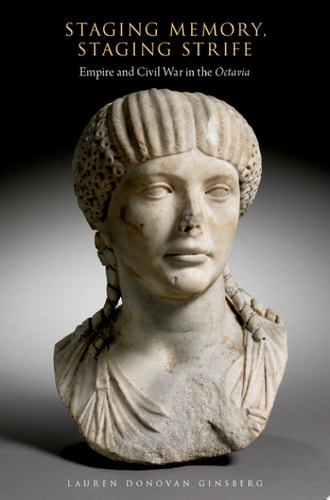
Staging Memory, Staging Strife: Empire and Civil War in the Octavia
0
0
As an Amazon Associate and affiliate partner, Menrva Books earns from qualifying purchases. Learn more
Author Description
The turbulent decade of the 60s CE brought Rome to the brink of collapse. It began with Nero's ruthless elimination of Julio-Claudian rivals and ended in his suicide and the civil wars that followed. Suddenly Rome was forced to confront an imperial future as bloody as its Republican past and a ruler from outside the house of Caesar. The anonymous historical drama Octavia is the earliest literary witness to this era of uncertainty and upheaval. In Staging Memory, Staging Strife, Lauren Donovan Ginsberg offers a new reading of how the play intervenes in the contests over memory after Nero's fall. Though Augustus and his heirs had claimed that the Principate solved Rome's curse of civil war, the play reimagines early imperial Rome as a landscape of civil strife with a ruling family waging war both on itself and on its people. In doing so, the Octavia shows how easily empire becomes a breeding ground for the passions of discord. In order to rewrite the history of Rome's first imperial dynasty, the Octavia engages with the literature of Julio-Claudian Rome, using the words of Rome's most celebrated authors to stage a new reading of that era and its ruling family. In doing so, the play opens a dialogue about literary versions of history and about the legitimacy of those historical accounts. Through an innovative combination of intertextual analysis and cultural memory theory, Ginsberg contextualizes the roles that literature and the literary manipulation of memory play in negotiating the transition between the Julio-Claudian and Flavian regimes. Her book claims for the Octavia a central role in current debates over both the ways in which Nero and his family were remembered as well as the politics of literary and cultural memory in the early Roman empire.
Menrva's Summary
THE THESIS
How does the anonymous Roman drama Octavia function as a site of political and historical contestation during the transition between the Julio-Claudian and Flavian dynasties? Lauren Donovan Ginsberg, a scholar of Roman literature and history, utilizes intertextual analysis and cultural memory theory to argue that the play serves as a critical intervention in the post-Neronian struggle to define the legacy of the first imperial family. By examining the play's engagement with earlier Julio-Claudian literature, the author demonstrates how the text challenges the official imperial narrative that the Principate had successfully ended the cycle of civil war.
THE SCOPE MAP
What You Will Find
- Analysis of the anonymous historical drama Octavia as a primary source for post-Neronian political discourse.
- Application of cultural memory theory to Roman imperial literature.
- Intertextual examination of the play's relationship to the broader corpus of Julio-Claudian era writing.
- Investigation into the transition from the Julio-Claudian to the Flavian regimes.
Scope Limits
- The study focuses primarily on the literary and political function of the Octavia rather than a comprehensive military or social history of the 60s CE.
- The analysis does not attempt to resolve the authorship debate surrounding the play.
THE AUTHORITY PERSPECTIVE
Scholars in the field of Classics recognize this work as a significant contribution to the study of Roman drama and the politics of memory. Readers frequently note the academic density of the prose and the rigorous intertextual methodology employed by the author to recontextualize the Octavia within the early imperial period.
Page Count:
243
Publication Date:
2016-01-01
Publisher:
Oxford University Press
ISBN-10:
0190649038
ISBN-13:
9780190649036
Drama
History
Humanities
Special Topics
Literary Criticism
Theatre
Rome
Roman Empire
Community Tags
Other Editions(2)
Similar Books