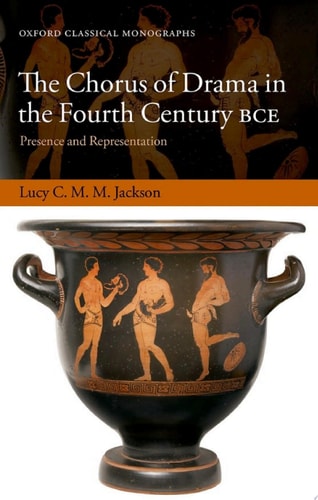
The Chorus of Drama in the Fourth Century BCE: Presence and Representation
0
0
As an Amazon Associate and affiliate partner, Menrva Books earns from qualifying purchases. Learn more
Author Description
The Chorus of Drama in the Fourth Century BCE seeks to upend conventional thinking about the development of drama from the fifth to the fourth centuries and to provide a new way of talking and thinking about the choruses of drama after the deaths of Euripides and Sophocles. Set in the context of a theatre industry extending far beyond the confines of the City Dionysia and the city of Athens, the identity of choral performers and the significance of their contribution to the shape and meaning of drama in the later Classical period (c.400-323) as a whole is an intriguing and under-explored area of enquiry. This volume draws together the fourth-century historical, material, dramatic, literary, and philosophical sources that attest to the activity and quality of dramatic choruses and, having considered the positive evidence for dramatic choral activity, provides a radical rethinking of two oft-cited yet ill-understood phenomena that have traditionally supported the idea that the chorus of drama 'declined' in the fourth century: the inscription of χοŕο*u~ με´ λο*s in papyri and manuscripts in place of fully written-out choral odes, and Aristotle's invocation of embolima (Poetics 1456a25-32). It also explores the important role of influential fourth-century authors such as Plato, Demosthenes, and Xenophon, as well as artistic representations of choruses on fourth-century monuments, in shaping later scholars' understanding of the dramatic chorus throughout the Classical period, reaching conclusions that have significant implications for the broader story we wish to tell about Attic drama and its most enigmatic and fundamental element, the chorus.
Menrva's Summary
THE THESIS
This work investigates the evolution and significance of the dramatic chorus in the fourth century BCE to challenge the prevailing narrative of its decline following the Classical period. Lucy C. M. M. Jackson, a scholar of Classical literature and performance, synthesizes historical, material, and philosophical evidence to re-evaluate the role of choral performers. By analyzing the broader theatre industry beyond Athens, the author provides a framework that reinterprets the transition of dramatic forms after the deaths of Sophocles and Euripides.
THE SCOPE MAP
What You Will Find
- Analysis of fourth-century historical, material, and literary sources regarding dramatic choruses.
- Re-examination of the term embolima as discussed in Aristotle's Poetics.
- Investigation into the influence of Plato, Demosthenes, and Xenophon on the perception of choral performance.
- Study of artistic representations of choruses on fourth-century monuments.
Scope Limits
- The study is primarily focused on the period between 400 and 323 BCE.
- The analysis does not attempt to provide a comprehensive history of all Greek drama, but specifically targets the choral element.
THE AUTHORITY PERSPECTIVE
Scholars in the field of Classical studies recognize this volume as a significant intervention in the study of post-Classical drama. Readers frequently note the academic density of the prose and the rigorous methodology applied to the re-evaluation of primary source evidence.
Page Count:
302
Publication Date:
2019-01-01
Publisher:
OUP Oxford
ISBN-10:
0192582895
ISBN-13:
9780192582898
Drama
History
Theater greece
Greek drama
Special Topics
Theatre
Ancient Greece
Humanities
Literary Criticism
Community Tags
Similar Books