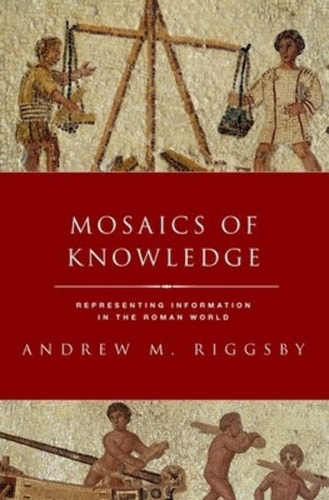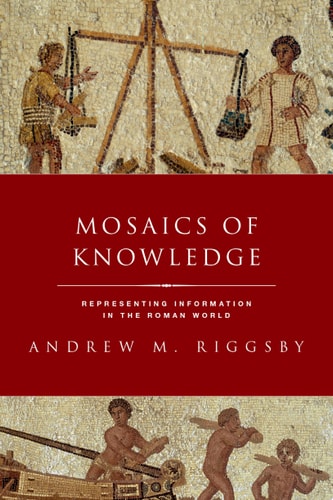
Mosaics of Knowledge: Representing Information in the Roman World
0
0
As an Amazon Associate and affiliate partner, Menrva Books earns from qualifying purchases. Learn more
Author Description
Today's information technology often seems to take on a life of its own, spreading into every part of our lives. In the Roman world things were different. Technologies were limited to small, scattered social groups. By examining five technologies-lists, tables, weights and measures, artistic perspective, and mapping-Mosaics of Knowledge demonstrates how the Romans broke up a world we might have imagined them to unite. That is, the recording, storage, and recall of information in physical media might be expected to bind together persons distant in time and space. More often than not, however, Roman instances serve to create or reinforce the isolation of particular groups. Persons in different "locations"- whether those are geographical, social, or occupational-had access to quite different informational resources, and the overall situation is thus not controlled by the needs of any particular class or group. On the one hand, these constraints on use in turn constrain the development and power of individual technologies. Development is slow, scattered, and far from one-directional. On the other, seeming technological weaknesses can turn out to be illusory if we set them in actual use-contexts. Romans deploy no more but also no less "computing" power than needed for very narrowly defined goals. This study combines detailed readings of a wide variety of evidence (inscriptions, small archeological finds, artworks, literary texts) with theoretical consideration of the social, cognitive, and material contexts for their use to present a unique portrait of Roman IT capabilities, limitations, and habits.
Menrva's Summary
THE THESIS
How did the Roman approach to information technology shape social cohesion and the distribution of knowledge across the empire? Andrew M. Riggsby, a scholar of classical culture, investigates the material and cognitive constraints of Roman information systems. By analyzing how Romans utilized physical media, he argues that these technologies functioned not as tools for universal unification, but as mechanisms that reinforced the isolation of specific social, occupational, and geographical groups.
THE SCOPE MAP
What You Will Find
- Analysis of five specific Roman technologies: lists, tables, weights and measures, artistic perspective, and mapping.
- Theoretical frameworks regarding the social and cognitive contexts of information storage and recall.
- Synthesis of diverse evidence including inscriptions, archaeological artifacts, and literary sources.
Scope Limits
- The study does not provide a comprehensive history of all Roman administrative practices.
- It does not attempt to compare Roman information systems to modern digital infrastructures in a direct, one-to-one technological evolution.
THE AUTHORITY PERSPECTIVE
Scholars frequently cite this work for its innovative application of information theory to the study of the ancient world. Experts highlight the text as a significant contribution to understanding how material culture and social structure intersected in Roman society.
Page Count:
264
Publication Date:
2019-01-01
Publisher:
Oxford University Press
ISBN-10:
0190632526
ISBN-13:
9780190632526
History
Professional Career & Trade
Roman History
Archaeology
Technology history
Ancient History
Earth Sciences
Information Science
History of Architecture
Mosaics