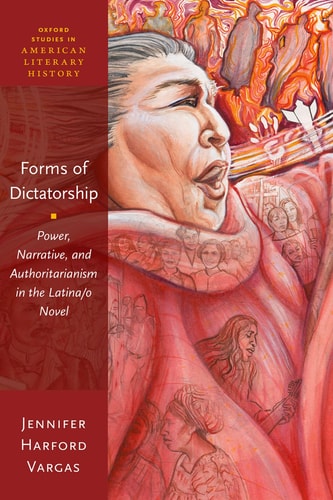
Forms of Dictatorship: Power, Narrative, and Authoritarianism in the Latina/o Novel
0
0
As an Amazon Associate and affiliate partner, Menrva Books earns from qualifying purchases. Learn more
Author Description
An intra-ethnic study of Latina/o fiction written in the United States from the early 1990s to the present, Forms of Dictatorship examines novels that depict the historical reality of dictatorship and exploit dictatorship as a literary trope. This literature constitutes a new sub-genre of Latina/o fiction, which the author calls the Latina/o dictatorship novel. The book illuminates Latina/os' central contributions to the literary history of the dictatorship novel by analyzing how Latina/o writers with national origin roots in the Caribbean, Mexico, and Central and South America imaginatively represent authoritarianism. The novels collectively generate what Harford Vargas terms a "Latina/o counter-dictatorial imaginary" that positions authoritarianism on a continuum of domination alongside imperialism, white supremacy, heteropatriarchy, neoliberalism, and border militarization. Focusing on novels by writers such as Junot Díaz, Héctor Tobar, Cristina García, Salvador Plascencia, and Francisco Goldman, the book reveals how Latina/o dictatorship novels foreground more ubiquitous modes of oppression to indict Latin American dictatorships, U.S. imperialism, and structural discrimination in the U.S., as well as repressive hierarchies of power in general. Harford Vargas simultaneously utilizes formalist analysis to investigate how Latina/o writers mobilize the genre of the novel and formal techniques such as footnotes, focalization, employment, and metafiction to depict dictatorial structures and relations. In building on narrative theories of character, plot, temporality, and perspective, Harford Vargas explores how the Latina/o dictatorship novel stages power dynamics. Forms of Dictatorship thus queries the relationship between different forms of power and the power of narrative form -- that is, between various instantiations of repressive power structures and the ways in which different narrative structures can reproduce and resist repressive power.
Menrva's Summary
THE THESIS
How do contemporary Latina/o novels utilize narrative form to represent, critique, and resist the structures of authoritarianism? Jennifer Harford Vargas, a scholar of Latina/o literature, investigates the emergence of the "Latina/o dictatorship novel" as a distinct sub-genre. By analyzing works from the 1990s to the present, she argues that these authors position dictatorial power on a continuum that connects Latin American political regimes with U.S. imperialism, white supremacy, and neoliberalism.
THE SCOPE MAP
What You Will Find
- A comparative analysis of novels by authors including Junot Díaz, Héctor Tobar, Cristina García, Salvador Plascencia, and Francisco Goldman.
- An examination of formal literary techniques such as footnotes, metafiction, and non-linear temporality as tools for depicting power.
- A theoretical framework defining the "Latina/o counter-dictatorial imaginary."
Scope Limits
- The study focuses specifically on Latina/o fiction written in the United States and does not provide an exhaustive history of Latin American political science.
- The analysis is limited to the period from the early 1990s to the present.
THE AUTHORITY PERSPECTIVE
Scholars in the field of ethnic studies and literary theory recognize this work as a significant contribution to the study of how narrative form intersects with political critique. Readers frequently note the academic density of the prose, which is intended for an audience familiar with postcolonial theory and formalist literary analysis.
Page Count:
0
Publication Date:
2017-01-01
Publisher:
Oxford University Press
ISBN-10:
0190642882
ISBN-13:
9780190642884
Latino Studies
Literary Criticism
Literary theory
Community Tags
Other Editions(2)
Similar Books


Reader Comments
Share Your Thoughts
No comments yet. Be the first to share your thoughts!