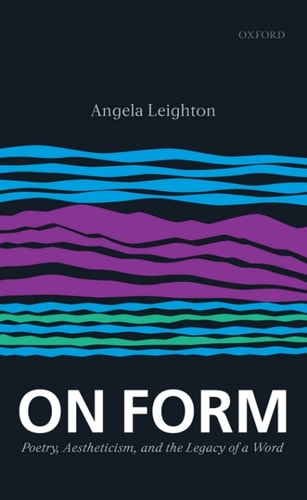
On Form: Poetry, Aestheticism, and the Legacy of a Word
0
0
As an Amazon Associate and affiliate partner, Menrva Books earns from qualifying purchases. Learn more
Author Description
What is form? Why does form matter? In this imaginative and ambitious study, Angela Leighton assesses not only the legacy of Victorian aestheticism, and its richly resourceful keyword, 'form', but also the very nature of the literary. She shows how writers, for two centuries and more, have returned to the idea of form as something which contains the secret of art itself. She tracks the development of the word from the Romantics to contemporary poets, and offers close readings of, among others, Tennyson, Pater, Woolf, Yeats, Stevens, and Plath, to show how form has provided the single most important way of accounting for the movements of literary language itself. She investigates, for instance, the old debate of form and content, of form as music or sound-shape, as the ghostly dynamic and dynamics of a text, as well as its long association with the aestheticist principle of being 'for nothing'. In a wide-ranging and inventive argument, she suggests that form is the key to the pleasure of the literary text, and that that pleasure is part of what literary criticism itself needs to answer and convey.
Menrva's Summary
THE THESIS
This study investigates the historical development and critical significance of the concept of 'form' within literary theory and practice. Angela Leighton, a scholar of Victorian literature and aestheticism, examines how the term has evolved from the Romantic era to the contemporary period. She argues that form serves as the primary mechanism for understanding the mechanics of literary language and the inherent pleasure found in artistic texts.
THE SCOPE MAP
What You Will Find
- Historical analysis of the term 'form' from the Romantic period to the present day.
- Close readings of major authors including Tennyson, Pater, Woolf, Yeats, Stevens, and Plath.
- Exploration of the relationship between form and content, sound, and aestheticist principles.
Scope Limits
- The text focuses primarily on English-language poetry and prose rather than global literary traditions.
- It does not provide a comprehensive history of all literary theory, focusing specifically on the aestheticist tradition.
THE AUTHORITY PERSPECTIVE
Scholars frequently cite this work for its nuanced approach to the intersection of aestheticism and formalist criticism. Experts note that the text provides a sophisticated framework for analyzing the relationship between literary structure and reader experience.
Page Count:
288
Publication Date:
2007-01-01
Publisher:
Oxford University Press
ISBN-10:
019156432X
ISBN-13:
9780191564321
Poetry
Literary Criticism
Literary theory
English
English & College Success
Victorian
Literary Form
Modernism
Form Aesthetics
Aestheticism
Community Tags
Similar Books