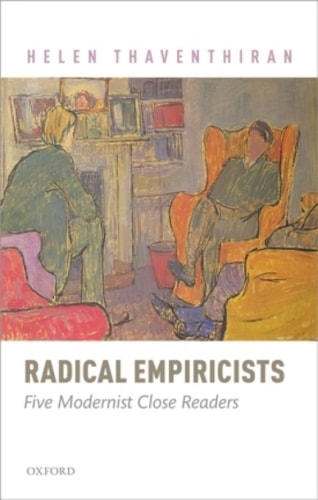
Radical Empiricists: Five Modernist Close Readers
0
0
As an Amazon Associate and affiliate partner, Menrva Books earns from qualifying purchases. Learn more
Author Description
Radical Empiricists presents a new history of criticism in the first half of the twentieth-century, against the backdrop of the modernist crisis of meaning. Our received idea of modernist criticism is that its novelty lay in being very empirical: critics believed in looking closely at words on the page. Such close reading has since been easy to ridicule but my book seeks to consider whether this is fair: have we, in the rush either to dismiss, or even to defend, the idea of close reading, often failed to look closely at what it involves in practice? Against this oversight, Radical Empiricists turns close reading back on itself, proposing some innovative readings of the prose of five major modernist poet-critics: I.A. Richards, T.S. Eliot, William Empson, R.P. Blackmur, and Marianne Moore. The book is divided into two parts, preceded by an introduction that explores what these five writers share: a radical self-consciousness about the key critical concept, 'meaning'. Part I, 'How to read', considers the prose techniques of Eliot, Richards and Empson as they push at the boundaries of verbal analysis in other disciplines: experimental psychology and anthropology, classical commentary and textual criticism. Part II introduces Blackmur and Moore, alongside Empson, and takes a more polemical look at how their critical styles defy various modernist orthodoxies about 'how not to read' (for example, that paraphrase always destroys poetic meaning). Many of these orthodoxies remain current: re-visiting their history, and attending to the rich detail of critical prose styles, can allow us to lift some old, unreflective constraints on our ways of knowing about poems.
Menrva's Summary
THE THESIS
This book investigates whether the historical practice of modernist close reading has been unfairly dismissed or misunderstood by contemporary scholars. Helen Thaventhiran, a scholar of twentieth-century literature, examines the prose techniques of five influential poet-critics to determine if their methods were more nuanced than current critical orthodoxies suggest. By applying close reading to the critics themselves, the author argues that these figures possessed a radical self-consciousness regarding the nature of meaning that remains relevant to modern analytical practices.
THE SCOPE MAP
What You Will Find
- A comparative analysis of I.A. Richards, T.S. Eliot, William Empson, R.P. Blackmur, and Marianne Moore.
- An examination of how critical prose intersects with experimental psychology, anthropology, and classical commentary.
- A critique of established academic orthodoxies regarding the relationship between paraphrase and poetic meaning.
Scope Limits
- The analysis is restricted to the first half of the twentieth century.
- The study focuses specifically on the prose styles of these five figures rather than a comprehensive history of all modernist criticism.
THE AUTHORITY PERSPECTIVE
Scholars view this text as a rigorous re-evaluation of the foundational methodologies of modernist literary criticism. Readers frequently note the academic density of the prose and the author's precise attention to the technical mechanics of critical writing.
Page Count:
288
Publication Date:
2015-01-01
Publisher:
OUP Oxford
ISBN-10:
0191061700
ISBN-13:
9780191061707
Literary Criticism
Academic
Modernism
English & College Success
Literary theory
English
Criticism history
Poetry Studies
Community Tags
Similar Books