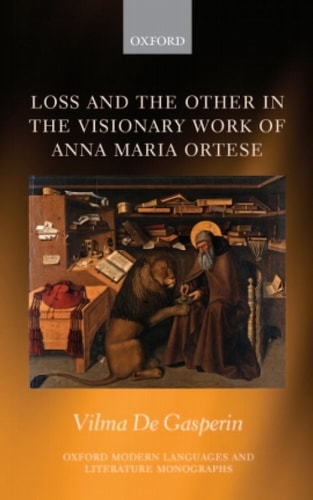
Loss and the Other in the Visionary Work of Anna Maria Ortese
0
0
As an Amazon Associate and affiliate partner, Menrva Books earns from qualifying purchases. Learn more
Author Description
This book examines the œvre of Anna Maria Ortese (1914-1998) from her first literary writings in the Thirties to her great novels in the Nineties. The analysis focusses on two interweaving core themes, loss and the Other. It begins with the shaping of personal loss of an Other following death, separation, abandonment, coupled with melancholy for life's transience as depicted in autobiographical works and in her masterpiece Il porto di Toledo. The book then addresses Ortese's literary engagement with social themes in realist stories set in post-war Naples in her collection Il mare non bagna Napoli and then explores her continuing preoccupation with socio-ethical issues, imbued with autobiographical elements, in non-realist texts, including her masterful novels L'Iguana, Il cardillo addolorato and Alonso e i visionari The book combines theme and genre analysis, highlighting Ortese's adoption and hybridization of diverse literary forms such as poetry, the novel, the short story, the essay, autobiography, realism, fairy tales, fantasy, allegory. In her work Ortese weaves an ongoing dialogue with literary and non-literary works, through direct quotations, allusions, echoes, adoption of motifs and topoi. The book thus highlights the intertextual relationship with her sources: Leopardi, Dante, Petrarch, Manzoni, Collodi, Montale, Serao; Shakespeare, Milton, Keats, Blake, Joyce, Conrad, Melville, Poe, Hawthorne, Hardy; Manrique, Gongora, de Quevedo, Villalón, Bello, Cantar del mio Cid; Heine, Valery, Puccini's Madam Butterfly, folklore, popular songs, and the Bible. Ortese thus shapes her literary themes in the background of social, political and economic upheavals over six decades of Italian history, culminating in an allegorical critique of modernity and a call for a renewed bond between humans and the Other.
Menrva's Summary
THE THESIS
This book investigates how the concepts of loss and the Other function as central, interweaving thematic pillars throughout the six-decade literary career of Anna Maria Ortese. Vilma De Gasperin, an expert in modern languages, utilizes a comprehensive analysis of Ortese's bibliography—ranging from early writings in the 1930s to her final novels in the 1990s—to demonstrate how the author navigated personal grief and socio-ethical concerns. The study posits that Ortese’s work serves as an allegorical critique of modernity, ultimately advocating for a re-established connection between humanity and the Other.
THE SCOPE MAP
What You Will Find
- A chronological examination of Ortese's oeuvre, including 'Il porto di Toledo', 'Il mare non bagna Napoli', 'L'Iguana', and 'Il cardillo addolorato'.
- An analysis of genre hybridization, covering realism, fairy tales, fantasy, and autobiography.
- A detailed mapping of intertextual relationships with authors such as Dante, Leopardi, Shakespeare, and Joyce.
Scope Limits
- The study focuses primarily on the thematic evolution of loss and the Other rather than providing a comprehensive biographical account of Ortese's private life.
THE AUTHORITY PERSPECTIVE
Scholars recognize this monograph as a rigorous academic resource for understanding the complex stylistic shifts in Ortese's writing. The text is noted for its dense, scholarly approach to intertextuality and its precise categorization of Ortese's diverse literary output.
Page Count:
320
Publication Date:
2014-01-01
Publisher:
OUP Oxford
ISBN-10:
0191655112
ISBN-13:
9780191655111
Biography
English & College Success
Literary theory
English
Italian
Literary Criticism
Modernism