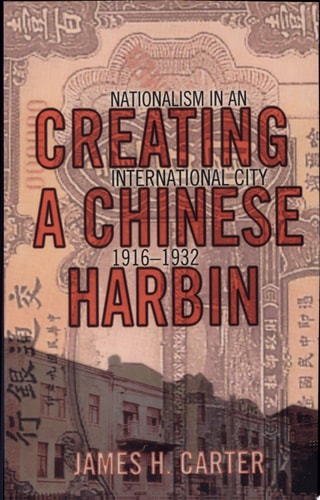
Creating a Chinese Harbin Nationalism in an International City, 1916-1932
0
0
As an Amazon Associate and affiliate partner, Menrva Books earns from qualifying purchases. Learn more
Author Description
James H. Carter outlines the birth of Chinese nationalism in an unlikely setting: the international city of Harbin. Planned and built by Russian railway engineers, the city rose quickly from the Manchurian plain, changing from a small fishing village to a modern city in less than a generation. Russian, Chinese, Korean, Polish, Jewish, French, and British residents filled this multiethnic city on the Sungari River. The Chinese took over Harbin after the October Revolution and ruled it from 1918 until the Japanese founded the puppet state of Manchukuo in 1932. In his account of the radical changes that this unique city experienced over a brief span of time, Carter examines the majority Chinese population and its developing Chinese identity in an urban area of fifty languages. Originally, Carter argues, its nascent nationalism defined itself against the foreign presence in the city?while using foreign resources to modernize the area. Early versions of Chinese nationalism embraced both nation and state. By the late 1920s, the two strands had separated to such an extent that Chinese police fired on Chinese student protesters. This division eased the way for Japanese occupation: the Chinese state structure proved a fruitful source of administrative collaboration for the area's new rulers in the 1930s.
Menrva's Summary
THE THESIS
This book investigates the formation of Chinese nationalism within the uniquely international and multiethnic city of Harbin during a pivotal period of its history. The narrative centers on the Chinese majority population as they developed a distinct national identity amidst a diverse urban landscape populated by speakers of fifty languages. Carter argues that this nascent nationalism initially defined itself in opposition to the foreign presence, paradoxically utilizing foreign resources for modernization, and that early forms of Chinese nationalism encompassed both national sentiment and state power. The book traces the evolution of this identity through the 1920s, highlighting a critical division between nation and state that ultimately facilitated the Japanese occupation.
THE SCOPE MAP
- The founding and rapid development of Harbin by Russian railway engineers.
- The diverse ethnic and linguistic makeup of Harbin's population, including Russian, Chinese, Korean, Polish, Jewish, French, and British residents.
- The Chinese administration of Harbin following the October Revolution until the Japanese occupation in 1932.
- The development of Chinese identity among the majority population in an international urban environment.
- The dual nature of early Chinese nationalism: defining itself against foreign presence while using foreign resources.
- The separation of national sentiment and state power by the late 1920s.
- The role of this internal division in paving the way for Japanese occupation and administrative collaboration.
THE AUTHORITY PERSPECTIVE
The book examines the complex origins of Chinese nationalism in the international city of Harbin, detailing its development from 1916 to 1932. It highlights how the Chinese majority forged an identity in a multiethnic environment, initially by contrasting themselves with foreign influences while simultaneously leveraging foreign investment for modernization. The analysis further explores the critical divergence between national sentiment and state power that emerged by the late 1920s, a division that ultimately proved consequential for the city's political future. The work's focus on this specific urban context offers a nuanced perspective on the broader currents of Chinese nationalism during a turbulent era.
Page Count:
217
Publication Date:
2002-01-01
Publisher:
Cornell University Press
ISBN-10:
0801439663
ISBN-13:
9780801439667
Non-Fiction
History
Asian History
International relations
Urban History
Nationalism
Community Tags
Similar Books