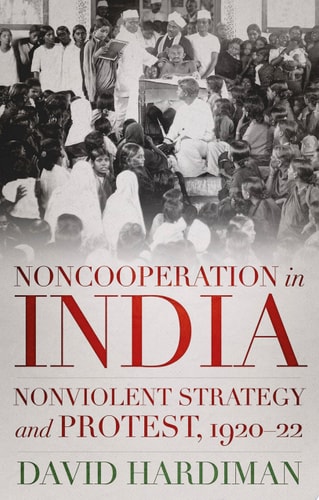
Noncooperation in India: Nonviolent Strategy and Protest, 1920-22
0
0
As an Amazon Associate and affiliate partner, Menrva Books earns from qualifying purchases. Learn more
Author Description
The Noncooperation Movement of 1920-22, led by Mahatma Gandhi, challenged every aspect of British rule in India. It was supported by people from all levels of the social hierarchy and united Hindus and Muslims in a way never again achieved by Indian nationalists. It was remarkably nonviolent. In all, it was one of the major mass protests of modern times. Yet there are almost no accounts of the entire movement, although many aspects of it have been covered by local-level studies. This volume both brings together and builds on these studies, looking at fractious all-India debates over strategy; the major grievances that drove local-level campaigns; the ways leaders braided together these streams of protest within a nationalist agenda; and the distinctive features of popular nonviolence for a righteous cause.David Hardiman's previous volume, The Nonviolent Struggle for Indian Freedom, examined the history of nonviolent resistance in the Indian nationalist movement. The present volume takes his study forward to examine the culmination of this first surge of struggle. While the campaign of 1920-22 did not achieve its desired objective of immediate self-rule, it did succeed in shaking to the core the authority of the British in India.
Menrva's Summary
THE THESIS
This volume investigates the strategic, social, and political dynamics of the 1920-22 Noncooperation Movement in India to determine how a mass-scale nonviolent protest challenged the foundations of British colonial authority. David Hardiman, a historian specializing in Indian nationalist movements, synthesizes local-level case studies with national-level political debates to provide a comprehensive account of this pivotal era. He examines how Gandhi and other nationalist leaders integrated diverse regional grievances into a unified, nonviolent campaign for self-rule. The work argues that while the movement did not secure immediate independence, it fundamentally destabilized the legitimacy of British rule in the subcontinent.
THE SCOPE MAP
What You Will Find
- Analysis of the 1920-22 Noncooperation Movement within the Indian nationalist struggle.
- Examination of the integration between local-level grievances and national political strategy.
- Evaluation of the mechanics and distinctive features of popular nonviolent resistance.
- Synthesis of regional historical studies into a cohesive national narrative.
THE AUTHORITY PERSPECTIVE
Scholars and historians recognize this work as a significant contribution to the study of Indian nationalism, particularly for its ability to bridge the gap between micro-level regional history and macro-level political analysis. Readers frequently note the clarity of Hardiman's prose and his success in documenting a movement that has historically lacked a comprehensive, unified account.
Page Count:
426
Publication Date:
2021-01-01
Publisher:
Oxford University Press
ISBN-10:
0197580572
ISBN-13:
9780197580578
History
India
Nonviolence
Asian History
Government - Asia
Colonialism
Nationalism
Community Tags
Similar Books