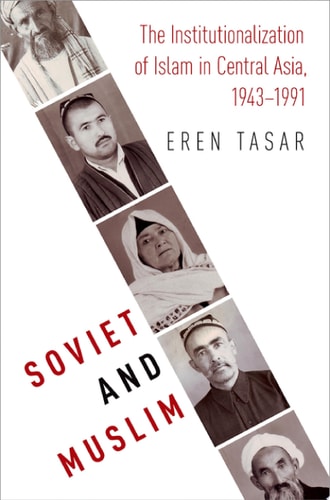
Soviet and Muslim: The Institutionalization of Islam in Central Asia
0
0
As an Amazon Associate and affiliate partner, Menrva Books earns from qualifying purchases. Learn more
Author Description
Central Asia was the sole Muslim region of the former Russian Empire that lacked a centralized Islamic organization, or muftiate. When Soviet leader Joseph Stalin created such a body for the region as part of his religious reforms during World War II, he acknowledged that the Muslim faith could enjoy some legal protection under Communist rule. From a skeletal and disorganized body run by one family of Islamic scholars out of a modest house in Tashkent's old city, this muftiate acquired great political importance in the eyes of Soviet policymakers and equally significant symbolic significance for many Muslims. Relying on recently declassified Central Asian archival sources, most of them never seen before by historians, Eren Tasar argues that Islam did not merely "survive" the decades from World War II until the Soviet collapse in 1991, but actively shaped the political and social context of Soviet Central Asia. Muslim figures, institutions, and practices evolved in response to the social and political reality of Communist rule. Through an analysis that spans all aspects of Islam under Soviet rule-from debates about religion inside the Communist Party, to the muftiate's efforts to acquire control over mosques across Central Asia, changes in Islamic practices and dogma, and overseas propaganda targeting the Islamic World-Soviet and Muslim offers a radical new reading of Islam's resilience and evolution under atheism.
Menrva's Summary
THE THESIS
This book investigates how the institutionalization of Islam under the Soviet muftiate in Central Asia functioned as a dynamic political and social force rather than a static relic of the past. Eren Tasar, a historian specializing in Central Asian studies, utilizes previously classified archival materials to challenge the narrative that Islam merely survived under Communist rule. He argues that the muftiate, established by Stalin during World War II, became a critical site of negotiation where Muslim leaders and Soviet officials actively shaped the region's religious and political landscape until 1991.
THE SCOPE MAP
What You Will Find
- Analysis of the administrative evolution of the Central Asian muftiate from its inception in Tashkent.
- Examination of internal Communist Party debates regarding the management of religious populations.
- Documentation of the muftiate's efforts to exert control over regional mosques and religious dogma.
- Insights into the use of Islamic institutions for Soviet overseas propaganda.
Scope Limits
- The study focuses primarily on the institutional history of the muftiate rather than the private, unrecorded spiritual lives of individual believers.
- The analysis is geographically confined to the Central Asian republics of the former Soviet Union.
THE AUTHORITY PERSPECTIVE
Scholars and historians recognize this work as a significant contribution to the study of Soviet religious policy, noting its reliance on previously inaccessible archival data. Readers frequently highlight the academic rigor of the prose and the author's ability to provide a nuanced view of the complex relationship between atheistic state structures and religious institutions.
Page Count:
433
Publication Date:
2017-01-01
Publisher:
Oxford University Press
ISBN-10:
0190652128
ISBN-13:
9780190652128
Religion
History
European History
Central Asia
Asian History
Islam
Soviet Union
Community Tags
Similar Books