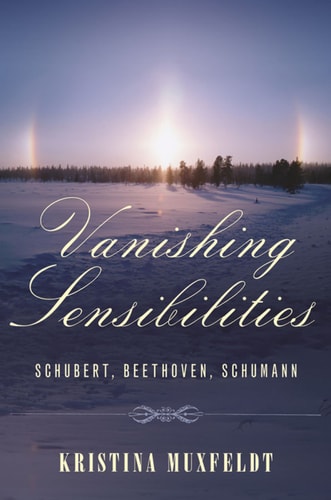
Vanishing Sensibilities: Schubert, Beethoven, Schumann
0
0
As an Amazon Associate and affiliate partner, Menrva Books earns from qualifying purchases. Learn more
Author Description
Vanishing Sensibilities examines once passionate cultural concerns that shaped music of Schubert, Beethoven, Schumann, and works of their contemporaries in drama or poetry. Music, especially music with text, was a powerful force in lively ongoing conversations about the nature of liberty, which included such topics as the role of consent in marriage, same-sex relationships, freedom of the press, and the freedom to worship (or not). Among the most common vehicles for stimulating debate about pressing social concerns were the genres of historical drama, and legend or myth, whose stories became inflected in fascinating ways during the Age of Metternich. Interior and imagined worlds, memories and fantasies, were called up in purely instrumental music, and music was privately celebrated for its ability to circumvent the restrictions that were choking the verbal arts. Author Kristina Muxfeldt invites us to listen in on these cultural conversations, dating from a time when the climate of censorship made the tone of what was said every bit as important as its literal content. At this critical moment in European history such things as a performer's delivery, spontaneous improvisation, or the demeanor of the music could carry forbidden messages of hope and political resistance--flying under the censor's radar like a carrier pigeon. Rather than trying to decode or fix meanings, Muxfeldt concerns herself with the very mechanisms of their communication, and she confronts distortions to meaning that form over time as the cultural or political pressures shaping the original expression fade and are eventually forgotten. In these pages are accounts of works successful in their own time alongside others that failed to achieve more than a liminal presence, among them Schubert's Alfonso und Estrella and his last opera project Der Graf von Gleichen, whose libretto was banned even before Schubert set to work composing it. Enlivening the narrative are generous music examples, reproduction
Menrva's Summary
THE THESIS
This book investigates how the music of Schubert, Beethoven, and Schumann functioned as a medium for political expression and social commentary within the restrictive climate of the Age of Metternich. Kristina Muxfeldt, a scholar of musicology, analyzes how composers utilized the nuances of performance, tone, and genre to communicate ideas about liberty, consent, and religious freedom that were otherwise suppressed by state censorship. By examining the intersection of music, drama, and poetry, the author argues that the aesthetic choices of these composers were deeply informed by the urgent political pressures of their era.
THE SCOPE MAP
What You Will Find
- Analysis of the relationship between musical composition and 19th-century European censorship laws.
- Case studies of specific works including Schubert's 'Alfonso und Estrella' and 'Der Graf von Gleichen'.
- Exploration of how instrumental music and vocal settings served as vehicles for political resistance.
- Discussion of cultural themes such as marriage consent, freedom of the press, and religious autonomy.
Scope Limits
- The text does not provide a comprehensive biography of the featured composers.
- It does not attempt to decode fixed meanings for every musical passage, focusing instead on the mechanisms of communication.
THE AUTHORITY PERSPECTIVE
Scholars and music historians frequently cite this work for its nuanced approach to the intersection of political history and musicology. Readers often note the academic density of the prose, which provides a rigorous examination of how cultural pressures shaped the musical output of the early 19th century.
Page Count:
272
Publication Date:
2011-01-01
Publisher:
Oxford University Press
ISBN-10:
0190208120
ISBN-13:
9780190208127
Humanities
Music History
19th Century
Musicology
Cultural History
Community Tags
Similar Books