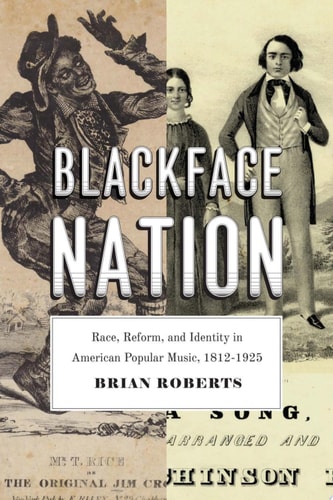
Blackface Nation: Race, Reform, and Identity in American Popular Music, 1812-1925
0
0
As an Amazon Associate and affiliate partner, Menrva Books earns from qualifying purchases. Learn more
Author Description
As the United States transitioned from a rural nation to an urbanized, industrial giant between the War of 1812 and the early twentieth century, ordinary people struggled over the question of what it meant to be American. As Brian Roberts shows in Blackface Nation, this struggle is especially evident in popular culture and the interplay between two specific strains of music: middle-class folk and blackface minstrelsy. The Hutchinson Family Singers, the Northeast's most popular middle-class singing group during the mid-nineteenth century, is perhaps the best example of the first strain of music. The group's songs expressed an American identity rooted in communal values, with lyrics focusing on abolition, women's rights, and socialism. Blackface minstrelsy, on the other hand, emerged out of an audience-based coalition of Northern business elites, Southern slaveholders, and young, white, working-class men, for whom blackface expressed an identity rooted in individual self-expression, anti-intellectualism, and white superiority. Its performers embodied the love-crime version of racism, in which vast swaths of the white public adored African Americans who fit blackface stereotypes even as they used those stereotypes to rationalize white supremacy. By the early twentieth century, the blackface version of the American identity had become a part of America's consumer culture while the Hutchinsons' songs were increasingly regarded as old-fashioned. Blackface Nation elucidates the central irony in America's musical history: much of the music that has been interpreted as black, authentic, and expressive was invented, performed, and enjoyed by people who believed strongly in white superiority. At the same time, the music often depicted as white, repressed, and boringly bourgeois was often socially and racially inclusive, committed to reform, and devoted to challenging the immoralities at the heart of America's capitalist order.
Menrva's Summary
THE THESIS
This book investigates the complex relationship between race, reform, and identity in American popular music from 1812 to 1925, arguing that blackface minstrelsy and middle-class folk music offered competing visions of American identity. Brian Roberts, drawing on extensive historical research, examines the evolution of popular music during a period of significant national transformation, from the War of 1812 to the early twentieth century. He contrasts the communal values and reformist ideals expressed in the music of groups like the Hutchinson Family Singers with the individualistic, white supremacist ideology embedded in blackface minstrelsy. The analysis highlights the central irony that music often perceived as authentically black and expressive was frequently invented and performed by white artists, while music seen as white and bourgeois often championed social and racial inclusivity.
THE SCOPE MAP
- An examination of the Hutchinson Family Singers as exemplars of middle-class folk music and its associated values.
- An analysis of blackface minstrelsy as a cultural force reflecting and shaping notions of white superiority and individual expression.
- Exploration of the audience-based coalition that supported blackface minstrelsy, including business elites, Southern slaveholders, and young white working men.
- Discussion of the 'love-crime' version of racism inherent in blackface performance, where adoration of stereotypical Black figures rationalized white supremacy.
- Tracing the shift in American consumer culture by the early twentieth century, where blackface identity became mainstream while reformist music faded.
- Elucidation of the paradoxes in American musical history, where perceived 'black' music was often white-invented, and perceived 'white' music was often socially inclusive.
THE AUTHORITY PERSPECTIVE
The book is regarded as a significant contribution to the understanding of American cultural history and the complex role of music in shaping national identity. It challenges conventional interpretations by highlighting the often-unacknowledged racial dynamics underlying popular music genres. The detailed historical analysis provides a nuanced perspective on the evolution of American self-perception through the lens of its musical output.
Page Count:
372
Publication Date:
2017-04-18
Publisher:
The University of Chicago Press
ISBN-10:
022645178X
ISBN-13:
9780226451787
History
Non-Fiction
American Studies
Cultural History
Race Relations
Music History
Community Tags
Similar Books