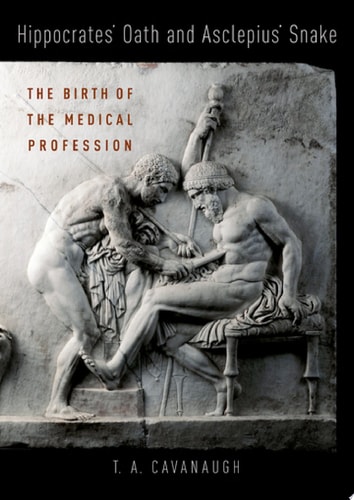
Hippocrates' Oath and Asclepius' Snake: The Birth of a Medical Profession
0
0
As an Amazon Associate and affiliate partner, Menrva Books earns from qualifying purchases. Learn more
Author Description
T. A. Cavanaugh's Hippocrates' Oath and Asclepius' Snake: The Birth of the Medical Profession articulates the Oath as establishing the medical profession's unique internal medical ethic - in its most basic and least controvertible form, this ethic mandates that physicians help and not harm the sick. Relying on Greek myth, drama, and medical experience (e.g., homeopathy), the book shows how this medical ethic arose from reflection on the most vexing medical-ethical problem -- injury caused by a physician -- and argues that deliberate iatrogenic harm, especially the harm of a doctor choosing to kill (physician assisted suicide, euthanasia, abortion, and involvement in capital punishment), amounts to an abandonment of medicine as an exclusively therapeutic profession. The book argues that medicine as a profession necessarily involves stating before others what one stands for: the good one seeks and the bad one seeks to avoid on behalf of the sick, and rejects the view that medicine is purely a technique lacking its own unique internal ethic. It concludes noting that medical promising (as found in the White Coat Ceremony through which U. S. medical students matriculate) implicates medical autonomy which in turn merits respect, including honoring professional conscientious objections.
Menrva's Summary
THE THESIS
This work investigates the origins and foundational principles of the Hippocratic Oath to determine if medicine possesses an inherent, internal ethic distinct from mere technical skill. Author T. A. Cavanaugh, a scholar in philosophy and bioethics, utilizes historical analysis, Greek mythology, and classical drama to construct his argument. He posits that the medical profession is defined by a commitment to therapeutic benefit and the avoidance of iatrogenic harm, specifically arguing against physician participation in practices such as euthanasia and abortion.
THE SCOPE MAP
What You Will Find
- Historical analysis of the Hippocratic Oath and its evolution.
- Philosophical examination of the physician-patient relationship.
- Integration of Greek mythology and drama to contextualize medical ethics.
- Discussion of modern medical rituals like the White Coat Ceremony.
Scope Limits
- The text does not provide a comprehensive history of all medical practices throughout antiquity.
- It focuses primarily on the moral philosophy of the profession rather than clinical medical procedures.
THE AUTHORITY PERSPECTIVE
Scholars and bioethicists frequently cite this work for its rigorous philosophical defense of traditional medical ethics. Readers note the academic density of the prose, which is primarily intended for students and professionals interested in the intersection of history and moral philosophy.
Page Count:
191
Publication Date:
2017-01-01
Publisher:
Oxford University Press
ISBN-10:
0190673680
ISBN-13:
9780190673680
History
Philosophy
Allied Health
Medicine history
Medical Ethics
Medical
Bioethics
Professionalism
Community Tags
Similar Books