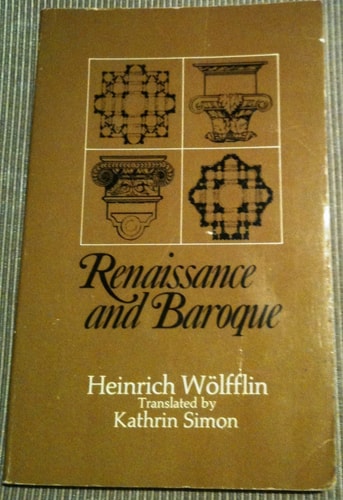
Renaissance and Baroque
0
0
As an Amazon Associate and affiliate partner, Menrva Books earns from qualifying purchases. Learn more
Author Description
...one of the most often cited source books on art...a penetrating inquiry into one of the great aesthetic problems: Why does a period in which proficiency in all branches of art and philosophy seems almost a way of life- in this instance the Renaissance- eventually peter out and die away? Wolfflin also touches on a related problem: Why is it that art cannot build on itself, consolidating its advances as the sciences can but has to be constantly in a process of revolution and change?
Menrva's Summary
THE THESIS
This work investigates the fundamental aesthetic transition between the Renaissance and Baroque periods, questioning why artistic styles inevitably shift rather than accumulating knowledge like the sciences. Heinrich Wölfflin, a seminal figure in formalist art history, utilizes a comparative methodology to analyze the visual language of these two eras. He argues that the evolution of art is governed by internal shifts in perception and formal structure rather than mere changes in subject matter or technical skill.
THE SCOPE MAP
What You Will Find
- Comparative analysis of Renaissance and Baroque visual characteristics
- Theoretical framework for stylistic evolution in art history
- Examination of formal elements such as linearity versus painterliness
- Discussion on the cyclical nature of artistic movements
THE AUTHORITY PERSPECTIVE
This text is regarded as a foundational pillar of formalist art history that continues to influence how scholars categorize stylistic shifts. The work provides a rigorous, albeit dense, methodology for observing art that remains a standard reference for students and historians alike.
Page Count:
182
Publication Date:
1984-01-01
Publisher:
Collins
ISBN-10:
0002173492
ISBN-13:
9780002173490
Aesthetics
Art History
Art Theory
Baroque Art