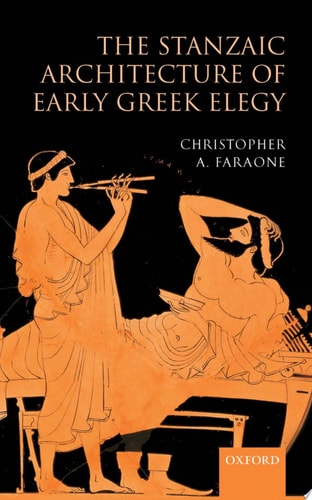
The Stanzaic Architecture of Early Greek Elegy
0
0
As an Amazon Associate and affiliate partner, Menrva Books earns from qualifying purchases. Learn more
Author Description
In this study of poetic form in early Greek elegy, Christopher A. Faraone argues against the prevailing assumption that it was a genre of stichic poetry derived from or dependent on epic verse. Faraone emphasizes the fact that early elegiac poets composed their songs to the tune of an aulos (a kind of oboe) and used a five-couplet stanza as a basic unit of composition. He points out how knowledge of the elegiac stanza can give us insight into how these poets alternated between stanzas of exhortation and meditation, used co-ordinated pairs of stanzas to construct lengthy arguments about excellence or proper human government, and created generic set pieces that they could deploy in longer compositions. Faraone's close analysis of nearly all the important elegiac fragments will greatly enhance understanding and appreciation of this poetic genre.
Menrva's Summary
THE THESIS
This study investigates whether early Greek elegy functioned as a stichic genre derived from epic verse or as a distinct form built upon specific stanzaic structures. Christopher A. Faraone, a scholar of ancient Greek literature, challenges traditional academic assumptions by analyzing the musical and formal constraints of the elegiac couplet. He argues that the integration of the aulos necessitated a five-couplet stanza as the fundamental unit of composition, which in turn dictated the thematic organization of the poems. By examining the structural mechanics of these fragments, Faraone provides a framework for understanding how poets constructed arguments and deployed generic set pieces within their work.
THE SCOPE MAP
What You Will Find
- Analysis of the five-couplet stanza as a primary unit of composition in early Greek elegy.
- Examination of the relationship between the aulos accompaniment and poetic structure.
- Close textual analysis of nearly all significant surviving elegiac fragments.
- Methodological insights into how poets alternated between exhortation and meditation.
THE AUTHORITY PERSPECTIVE
Scholars and classicists recognize this work as a significant intervention in the study of archaic Greek poetry, particularly for its focus on the intersection of performance and form. Readers frequently note the technical density of the prose, which is intended for those with a background in classical philology and ancient Greek prosody.
Page Count:
200
Publication Date:
2008-08-15
Publisher:
Oxford University Press
ISBN-10:
0199236984
ISBN-13:
9780199236985
Poetry
History
English & College Success
Ancient Greece
Criticism history
Greek language
Literary Criticism
English
Greek poetry
Community Tags
Similar Books